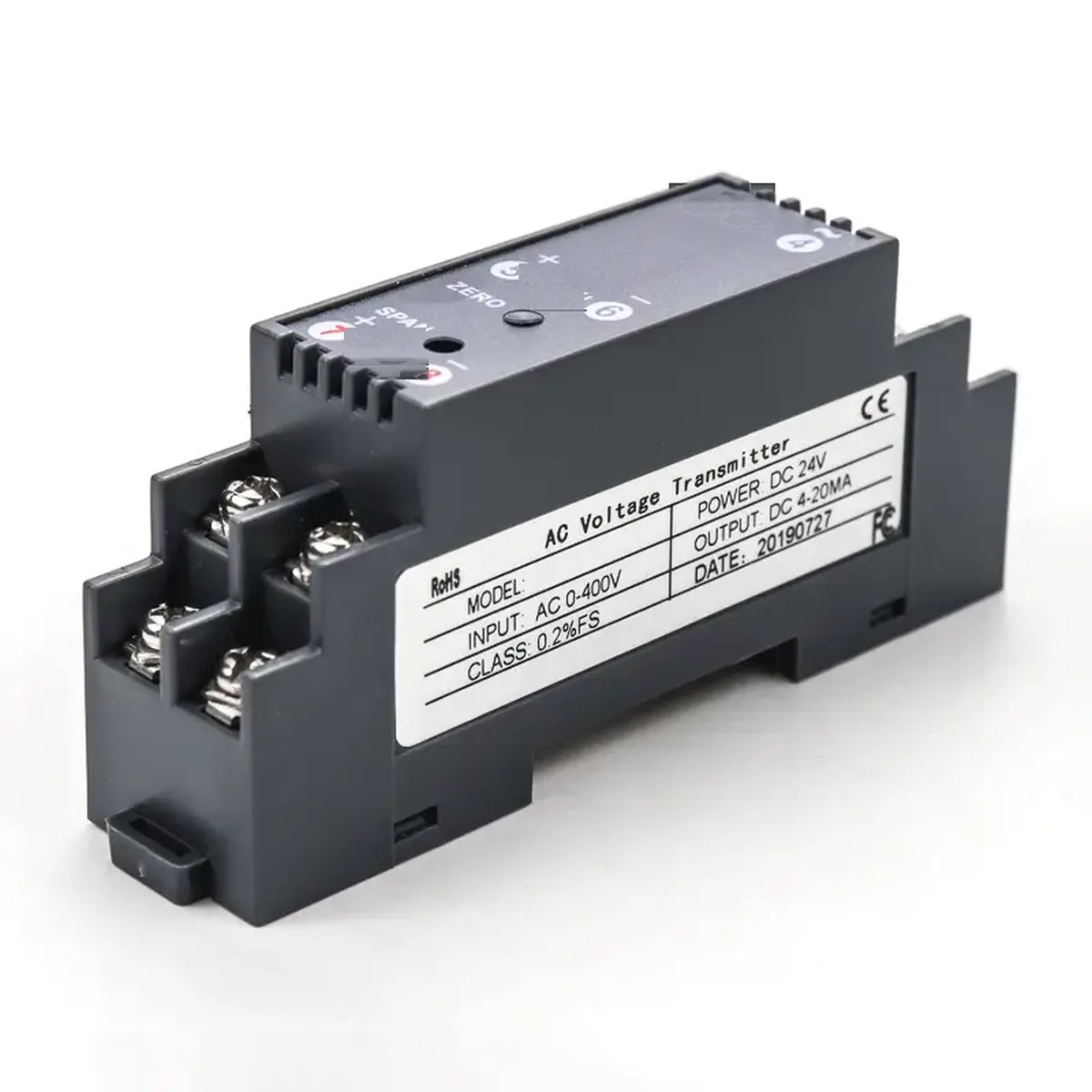
What a signal converter is
A signal converter takes a measurement in the form the process produces and turns it into the form the control system accepts. That may be a current into a voltage, a voltage into a current, a three-phase supply into a single analogue signal, or an analogue value onto a digital bus.
The boundary against its neighbours is what it does with the signal. A signal isolator passes a signal through while breaking the electrical path; a converter changes its form as well. A panel meter displays the value locally. A PLC input card accepts a signal but does not create one. A converter is the device between a sensor or a supply and the card that reads it.
What decides the choice is almost always the two ends rather than the middle: what the source produces, and what the controller will accept. The converter is selected to join them, and the isolation between the two ends is the property that makes the joint safe.
How a signal converter measures
The input stage adapts the source. A current transformer or a split core produces a small current proportional to the primary; a voltage divider produces a small voltage; a shunt produces a millivolt drop. The input stage scales that to a level the electronics can handle and, in doing so, isolates it from the output.
The output stage produces the standard signal. A 4-20 mA loop is the common choice because it is current-based, so the resistance of the wiring does not change the value, and because a loop current of zero is distinguishable from a live zero at 4 mA. Voltage outputs are used over short distances where the receiving card expects them. Digital outputs carry the value as a number and can carry several parameters over one pair.
Isolation is the property that makes the device useful rather than merely convenient. The input may sit on a 3000 A feeder and the output on a 24 V control system; the converter is what allows the two to share an enclosure without the control system inheriting the fault level of the feeder. The isolation voltage is a specification in its own right and is not implied by the function.
Configuration choices
Most of the specification is fixed by these decisions rather than by the accuracy class. Each one constrains the next, which is why they are settled in order.
| Configuration | Options to fix | What it actually decides |
| Input quantity | AC or DC current, AC or DC voltage, power, frequency, or a temperature sensor | What the device can measure. A current input cannot read a voltage without a different input stage, and a three-phase power form needs the voltage and current connections rather than a single conductor. |
| Input method | Through-bore, split core, direct connection, or a shunt | Whether the circuit has to be opened. A split core clamps around a cable that is already terminated; a through-bore needs the conductor passed through once; a direct connection needs the circuit isolated. |
| Output form | 4-20 mA, 0-20 mA, 0-10 V, 0-5 V, RS-485/Modbus or CAN | What can read the device. The controller decides this, and the choice is separate from the measurement. |
| Isolation | The voltage between input, output and supply | Whether the two circuits can share an enclosure safely. This is the figure that is most often assumed rather than specified. |
| Supply and mounting | 24 V DC, 12 V DC or 220 V AC, on a DIN rail | Whether the device fits the panel. A 220 V form can be fed from the panel supply; a 24 V form needs a supply that already exists. |
How to choose a signal converter
| Factor | Why it decides the answer | How to settle it before enquiring |
|---|
| Circuit type and rating | AC or DC, single or three phase, the nominal current and voltage, and the frequency | It decides the input stage and the range. A 5 A circuit and a 3000 A feeder use different input methods as well as different ranges. |
| Whether the circuit can be opened | A split core clamps in place; a through-bore needs the conductor passed through; a direct connection needs the circuit isolated | This is usually known before anything else, and it rules out half the options immediately. |
| What the controller accepts | The input card decides the output form, not the transducer | Give the card type and its input range, or the protocol the controller reads. |
| Isolation required | The input may be at a high fault level and the output at 24 V | State the highest voltage present on the input side and whether the two circuits share an enclosure. |
The nearest alternatives
These are the types an enquiry for a signal converter usually turns out to be, and the point at which the choice is genuinely decided.
| Nearest alternative | What separates it from a signal converter |
| Signal isolators | Passes a signal through while breaking the electrical path, without changing its form. A converter changes the form as well, so the two answer different questions: isolation is about safety, conversion is about compatibility. |
| PLC systems | Accepts the signal and acts on it. The converter is what makes the signal acceptable in the first place, and the two sit at opposite ends of the same cable. |
| Remote I/O | Moves many signals onto a network in one enclosure. A converter handles one or a few signals at the point where they are produced, which is often cheaper where the measurement is isolated. |
| Panel meters | Displays the value locally and sends nothing. Where the value has to reach a controller, a meter is not a substitute for a converter, although the two are often mounted side by side. |
Where a converter and an isolator are both needed, some devices combine the two; the specification should state which function is provided rather than assuming both.
What to include in the enquiry
The first reply can be a quotation rather than a set of questions if the enquiry carries these. Where a figure is not known, send the duty description and we will confirm what it implies.
- Circuit type: AC or DC, single or three phase, and the frequency
- Nominal current and voltage, and the range to be measured
- Whether the circuit can be opened, or a split core is needed
- Output form and the controller input it connects to
- Supply available in the enclosure
- Isolation voltage required between input, output and supply
- Number of channels and whether a multi-parameter form is needed
- Ambient conditions in the enclosure
- Quantity, destination port and required delivery date