What this category covers
Gas detection exists to protect people, so it is specified around the hazard rather than around a measurement. Which gases have to be detected, what concentration matters, how quickly the alarm has to arrive, and whether the instrument is worn by a person or fixed in an area - those questions decide the configuration, and performance figures come afterwards.
The two families behave quite differently. A portable detector is carried into a confined space or worn through a shift, so weight, battery life, robustness and a daily bump test dominate. A fixed system runs continuously with a controller, alarm relays and often voting logic between detectors, so coverage, placement and the consequence of a false alarm dominate instead.
Both depend on sensors that are calibrated against a certified test gas at defined intervals, and on sensor elements that are consumed or degraded over time. That makes the calibration regime and the sensor replacement route a real part of the specification rather than an operating detail - a detector whose sensor cannot be replaced locally has a maintenance lead time built into it.
Product types in gas detection & safety instruments
| Product type | How it senses | Usually specified for |
| Portable single-gas detector | One sensor element in a worn instrument with a local alarm | Personal protection through a shift, where one known hazard dominates and the instrument has to be light and simple to use |
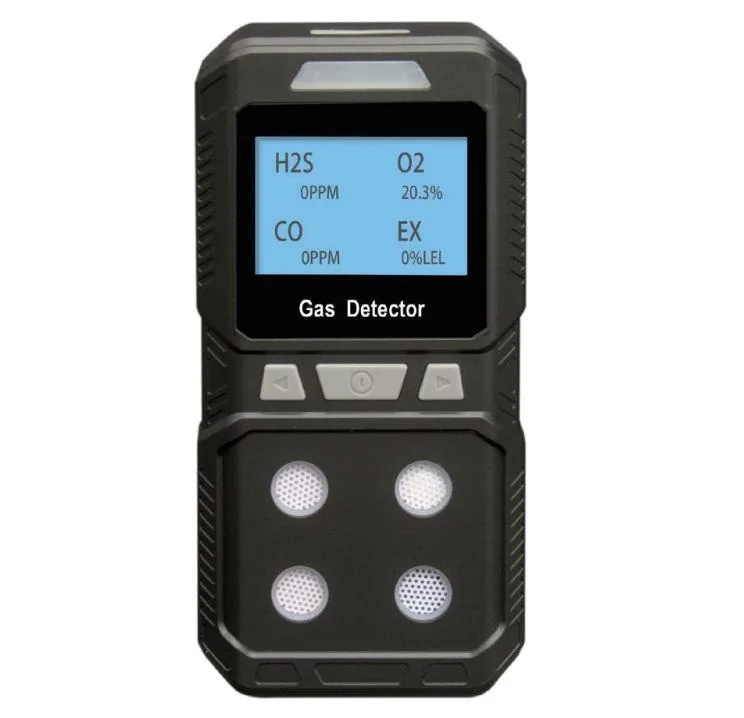
| Portable multi-gas detector | Several sensor elements in one instrument, commonly including oxygen and a combustible channel | Confined-space entry, where the atmosphere has to be checked for several hazards before and during entry |
| Fixed gas detector | A sensing head installed at a point and wired back to a controller or a control system | Area protection where the hazard is expected to accumulate at a known place, such as a valve, a pit or a compressor house |
| Combustible gas detector | Catalytic or infrared measurement of a flammable gas in air | Areas handling flammable gas or vapour, where the alarm is set as a fraction of the lower explosive limit |
| Toxic gas detector | An electrochemical cell selected for a specific substance | Areas where a known toxic gas could be released, and any exposure limit that has to be monitored continuously |
| Oxygen detector | An electrochemical cell measures oxygen directly, for both deficiency and enrichment | Confined spaces, inert-gas purging, and any room where displacement or consumption of oxygen is possible |
| Gas leak detector | A sensitive sensor used to locate a leak rather than to monitor an area | Commissioning, maintenance and leak surveys on pipework, joints and manifolds |
| Flame detector | Ultraviolet or infrared sensing of the radiation a flame emits | Areas where a fire could develop before gas accumulates, and where an ignition event rather than a concentration is the risk |
Gas detection systems, controllers and general industrial safety instruments are listed under this category as well.
How to choose a gas detector
There is rarely a single correct instrument for a duty, but there is always a
shortlist that can be justified and a set of answers that eliminates the rest. These
are the questions that decide it.
- Which gases have to be detected, and at what concentration. That answer alone removes most of the catalogue, because sensors are specific rather than general.
- Whether the requirement is personal protection or area protection, since the two lead to completely different instrument architectures.
- The alarm thresholds and what should happen when they are reached: local alarm, relay to a control system, shutdown, or all three.
- Where the hazard could appear, including low points, pits and enclosures, because gas collects where it is not looked for.
- The area classification and the protection concept the installation has to follow, which decides which instrument types are eligible.
- The regulatory and site requirements on the instrument itself, which in some locations impose approvals that narrow the choice sharply.
- The calibration regime: availability of test gas, the bump test interval, and who carries it out.
- Sensor life and the replacement route, since a detector whose cell cannot be replaced locally accumulates downtime.
- Whether the system has to keep working through a fault, which introduces redundancy, voting logic and fault-signalling requirements.
Working through the selection in order
- List the gases to be detected, with the concentration that matters for each one, and separate the toxic from the combustible.
- Decide whether the protection is personal, area-based, or both, and where each applies.
- Set the alarm thresholds and the action each one triggers, including anything that has to shut down.
- Establish the area classification and the site requirements that apply to the instrument.
- Choose the sensor technology for each gas - the same gas can need different technology in a clean room and in a foundry.
- Work out the placement and the number of detection points, including low points, pits and enclosures.
- Confirm the controller, the alarm and the signalling arrangement if a fixed system is involved.
- Fix the calibration and sensor replacement regime so that the installation can be maintained with what is available locally.
Comparing the technologies
| Sensor technology | Best suited to | Limits | Detects |
| Catalytic bead | Combustible gas where a broad response across many hydrocarbons is acceptable | Poisoned by silicones, sulphur compounds and lead, and needs oxygen present to measure at all | Combustible gas |
| Infrared | Combustible gas in locations where sensor poisoning would end the catalytic sensor life | Only responds to gases with a suitable absorption band, so some substances are outside its reach | Combustible gas, carbon dioxide |
| Electrochemical cell | Toxic gases and oxygen, at the concentrations exposure limits are written in | Consumed over time and needs replacing; cross-sensitivity between gases is common and has to be allowed for | Specific toxic gases, oxygen |
| Photoionisation | Volatile organic compounds at low concentration, and leaks of solvent vapour | The lamp energy decides which compounds respond, and the lamp and window are consumables | Volatile organic compounds |
| Metal-oxide semiconductor | General leak indication and trend detection at a modest cost | Affected by humidity and temperature, and not selective, so it indicates that something is present rather than what | Leak indication |
| Ultraviolet and infrared flame sensing | Flame itself, in areas where ignition could precede any significant gas cloud | False alarms from welding, hot work and sunlight unless the detection logic and the siting are set correctly | Flame |
Parameters to confirm before ordering
What is left after the technology is chosen is a list of values that only the
installation can supply. These are the ones that change the model, the price or the
lead time:
- The gases or vapours to be detected, with the concentration of interest for each.
- Whether the requirement is portable, fixed, or a combination of both.
- The alarm thresholds and the action that follows each one.
- The installation location, including whether the area is classified and to which standard.
- The number of detection points, and information on the geometry so that coverage can be considered.
- The controller and signalling arrangement, where a fixed system is involved.
- The calibration gas available, and how the instrument will be bump tested and calibrated.
- Sensor replacement expectations, and whether replacement is carried out on site.
- The documentation required, including any certificate the site or the authority expects.
- Whether personal issue or a fixed installation is intended, and the quantity for each.
Figures are quoted, not assumed
Specifications vary by model and application, so no performance figure is stated on
this page. Where a parameter has not been documented for a particular model, the
product page says so rather than filling the gap with a plausible number. Send the
values above and we will return the ones the selected model actually holds.
Where these instruments are used