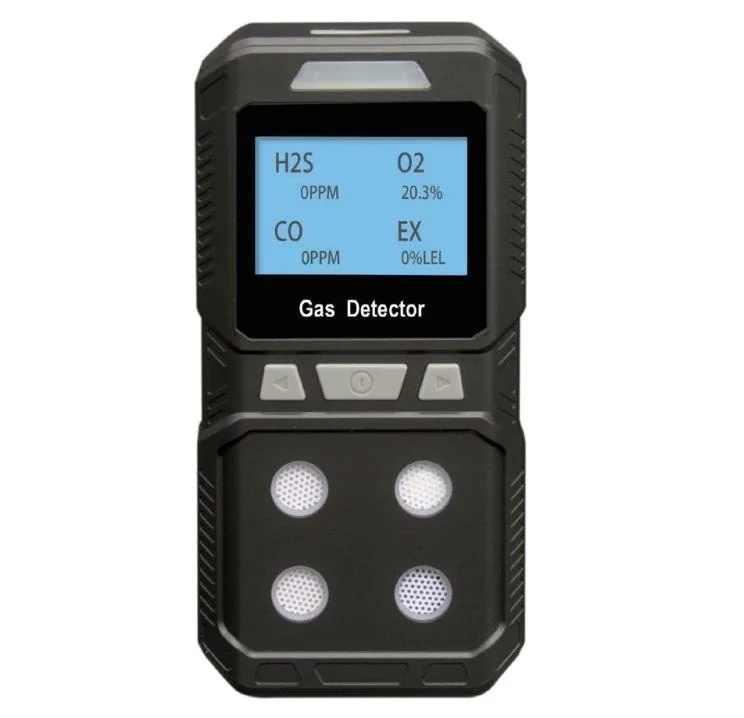
- Detection range
- 3 to 20 percent of the lower explosive limit, with sub-ranges of 0 to 1000 ppm and 0 to 100 percent of the lower explosive limit
- Alarm set point
- 10 percent of the lower explosive limit
- Indication error
- plus or minus 5 percent of the lower explosive limit
- Gases
- Methane, natural gas, biogas, hydrogen, coal gas, acetone, petrol and ethanol, with the material also naming oxides and sulfides and stating that organic combustible vapours from liquids such as petrol are detected
- Alarm
- A lamp, a vibration and a buzzer, each of which can be switched on or off separately from the menu
- Probe
- A flexible gooseneck hose that can be bent or straightened to reach confined spaces, with a metal-shrouded sensor at the tip
- Display
- A full-colour screen showing date and time, the gas name, the live concentration, a range scale, status text and the unit, and able to switch to a curve of the concentration over time
- Power
- An internal 2000 mAh cell at 3.7 V direct current, at least 8 hours on a full charge, charged over Type-C and able to run from a power bank
- Working environment
- minus 25 to 55 degrees Celsius and below 95 percent relative humidity, without condensation
- Body
- 161.4 x 69 x 31 mm and 0.275 kg, excluding the length of the hose
A gas leak is found by moving a sensor through the place where the gas would collect and watching for the reading to rise, and almost everything about a portable detector follows from that. The probe has to reach where a hand cannot, the alarm has to be noticed when the person holding it is looking at a pipe rather than at a screen, and the reading has to be steady enough to tell a leak from a background.
The instrument in this range is arranged around those three requirements rather than around an accuracy figure.
Product overview
Two designations of the same instrument are described, an earlier one and a later one that adds a prefix to the same number, despatched at random unless a particular one is established before the order. Their appearance and function are the same, and the difference is in the screen interface and the marking on the body. A basic battery form without a display is also offered in the material, indicating a leak rate with a lamp and alarming audibly and visually.
The measuring instrument reports a live concentration against a range and compares it to a fixed alarm point at 10 percent of the lower explosive limit. The range starts at 3 percent of that limit, which is the point that makes the instrument useful as a locator rather than only as an alarm.
How the sensor locates a leak
The sensor sits at the tip of a flexible hose, so it can be placed at a joint, a valve or a length of pipe while the body stays in the hand and the display stays visible. Combustible gas arriving at the tip produces a response that is converted into a reading against the lower explosive limit, and the instrument compares that reading to its alarm point.
The reason the scale is expressed as a fraction of the lower explosive limit rather than as a concentration is that the fraction is comparable between gases, while the concentration at which each gas becomes hazardous is not. It also means the reading is meaningful only against the gas named on the display, because one sensor response corresponds to a different concentration of methane than of petrol vapour. The alarm point at 10 percent of the limit sits well below the point of ignition, which is the purpose of an alarm that is meant to precede a hazard rather than mark it.
How to select the right leak detector
The first question is whether a number is needed or only a leak rate. The basic form answers the second with a lamp and an audible alarm and no display, and it is the quicker instrument for the person whose task is to walk a run of pipe and find the joint that is passing. The display instruments answer the first, with a live reading, a curve over time and a stored record.
The second is reach and access. A flexible hose that bends and straightens is what allows a sensor to be placed inside a cabinet, behind a panel or along the underside of a pipe run, and the length of the hose is part of the instrument rather than an accessory. The third is where the instrument will be used, because the working range of minus 25 to 55 degrees Celsius and the humidity limit are stated, and the provision for a certificate of conformity is a question about a classified area that has to be answered before entry.
Measurement limitations and selection considerations
The material gives a range, an error and an alarm point, and it names the gases, but it does not name the sensing principle, the sensor life, or the warm-up and response times, and it does not mention a zero adjustment, a calibration gas or a calibration interval. On the material as supplied the instrument is a locator whose reading is a relative indication within a stated band, and it cannot be presented as a calibrated analyser of gas concentration until those figures are established, because a combustible gas sensor drifts and ages and its reading is only as good as the adjustment behind it.
There is a second consideration in the way the instrument is used. A leak is found by moving the sensor slowly, because the gas has to reach the element, and a sensor swept past a joint quickly will show less than a sensor held at it. For the same reason the reading depends on where the gas has collected, which is a property of the space and not of the leak, and a joint that passes can read low in a draught. The curve display exists to make that distinction easier, by showing whether the rise is sustained as the probe is held or is a single sample that does not repeat.
Every value below is taken from source documentation. Where a parameter is not stated in the available material it is marked as information required rather than estimated.