Industry

Oil & Gas Instrumentation & Measurement Solutions

Flow, pressure, level and gas detection for upstream, midstream and downstream duties, including hazardous-area work.

What this sector has to measure

Oil and gas is the sector where the instrument specification is written by documents that have nothing to do with performance. An area classification drawing decides the protection concept, a piping specification decides the wetted materials and the flange standard, and a metering agreement decides which measurement is allowed for custody transfer. Only after those three are settled does accuracy become the deciding factor.

The sector also spans conditions that have no common answer. A wellhead sees high pressure, abrasive sand and wide temperature swings. A refinery unit sees hydrogen sulphide, high temperature and a corrosive service that changes with the feed. A terminal sees large storage tanks, exact inventory and a need for custody-grade figures. The same measurement - level, for example - is three different instruments in those three places.

That is why this page is organised by segment first and by measurement second. Buyers arriving with a duty usually know which part of the chain it belongs to, and that single answer removes more of the list than any performance figure will.

Where the instruments sit

Upstream and wellhead

High pressure, abrasive solids, vibration and remote locations with limited maintenance access. Instruments are specified for survivability and for a long interval between interventions; power is frequently unavailable and the reading is often needed locally as well as remotely.

Midstream: pipelines, compression and storage

Steady flow, large line sizes and a commercial value attached to the measurement. Custody transfer and fiscal duties sit here and follow an agreed standard rather than an accuracy preference. Pressure and temperature are used both to protect the line and to compensate the flow figure.

Downstream: refining and processing

Corrosive and hot service, variable feed quality and a plant that is normally classified throughout. Differential pressure across packed beds and filters, level under pressure and temperature across furnaces and columns are the recurring duties.

Terminals and loading

Batch movements, exact quantities, loading arms and tank farms. Level, flow and temperature all contribute to a single dispatched figure, so the instruments have to agree with each other rather than merely be individually accurate.

Instrumentation used in this sector

MeasurementWhat is measured in this sectorInstruments commonly specified
Flow Crude, refined product, natural gas, produced water, steam and flare lines; some duties carry a custody-transfer obligationCoriolis mass meters, ultrasonic meters, vortex meters, differential-pressure installations and turbine meters, with pressure and temperature compensation on gas and steam
Pressure Wellhead and line pressure, separator and vessel pressure, and differential across filters, beds and orifice platesPressure transmitters and differential transmitters, generally with diaphragm seals where the medium is sour, viscous or solid-bearing
Temperature Process streams, furnace and heater outlets, pipeline temperature used for flow compensationThermocouples for the hot and fast duties, RTDs with thermowells where the reading has to be stable and traceable
Level Storage tanks, separators, knock-out drums and interface between oil and waterRadar and guided-wave transmitters, hydrostatic transmitters for simple tanks, and independent point switches for high-level protection
Gas and flame detection Combustible gas, hydrogen sulphide, oxygen deficiency and flame in process and storage areasFixed and portable gas detectors with the sensor type matched to the target gas, and flame detectors for the area being protected
Analysis Moisture in gas, oxygen, hydrogen sulphide and water quality in produced water treatmentProcess analysers and transmitters, sited with attention to sample handling, because the sample system is usually the source of the error

The instrument list is a starting point, not a quotation. Which of these is appropriate depends on the segment, the area classification and the material specification for the specific line.

How to specify for a oil and gas installation

  1. Area classification first. The protection concept - intrinsic safety, flameproof, pressurised or increased safety - determines which instruments are eligible and how the cabling is installed. A quotation cannot be specific until this is stated, and changing it later usually changes the instrument.
  2. Wetted materials against the actual service, not the general description. Sour service, produced water and high-temperature hydrogen all attack standard stainless steel differently, and a material that is acceptable in one line may not be in the next. State the specification the project already uses.
  3. Custody transfer is a metering agreement, not an accuracy figure. Where a measurement carries a fiscal obligation, the standard, the proving method and the acceptable uncertainty are set by agreement between the parties, and the instrument follows from those rather than leading them.
  4. Temperature and pressure compensation on gas and steam. A volumetric reading without the line conditions behind it is not the number the commercial agreement refers to. Say whether the transmitter or the flow computer is expected to perform the compensation.
  5. Process connection and flange standard, since the site standard usually decides it and the instrument is supplied to match. Include the facing and the rating.
  6. Remote and unmanned locations. Power budget, communication route and the interval between maintenance visits frequently decide the design more than accuracy does.
  7. Documentation that has to accompany the order: material certificates, test certificates, calibration records and a declaration of conformity where the installation requires one. Say at the enquiry stage which of these is needed, because not all of them can be added afterwards.
  8. Traceability of the delivered items to the documentation. Where an instrument has to be evidence in a safety or metering case, the certificate has to correspond to the serial number that arrives, so the requirement belongs in the order rather than in a later email.

Standards and approvals that may apply

  • Hazardous-area certification schemes, which the installation may be required to carry. We confirm which approval a selected model holds, and we state it as unconfirmed where the documentation has not been supplied to us.
  • Pressure equipment and material specifications applied by the project, commonly expressed as a piping-class or material-selection standard.
  • Custody-transfer and metering standards referenced in the commercial agreement, which govern the measurement method rather than the instrument.
  • Environmental and emission monitoring requirements where the installation reports a measured value to a regulator.
  • We describe what the installation may have to meet. We do not claim that any approval is held for a product unless the certificate has been supplied to us, and the product pages follow the same rule.

Applications in this sector

Frequently asked

Oil & Gas sourcing questions

The questions that come up in this sector before an order. If yours is not here, send it with the duty and we will answer it alongside the quotation.

What does an oil and gas instrumentation enquiry need to include?

The segment and the duty, the medium and its composition where it matters, the area classification, the project material specification, the line size, and the pressure and temperature at the point of measurement. Where the measurement carries a commercial obligation, say so, because the standard behind it may decide the instrument before anything else does.

Which flow meter is used for custody transfer?

The metering agreement decides it. Custody transfer is a contractual measurement with a stated method and acceptable uncertainty, and the instrument is chosen to satisfy that agreement rather than on general merit. Coriolis, ultrasonic and differential-pressure installations all appear in this role, in different services and under different agreements. Tell us which standard applies and we will confirm what can be supplied against it.

Can instrumentation be supplied for a classified area?

Instruments for classified areas are supplied against a stated protection concept and a stated gas group and temperature class. What we cannot do is assume a classification: the zone, the group and the class come from the site drawing. Give us those three and we will confirm which models can be offered and which approvals correspond to them.

How is level measured in a crude storage tank?

Normally with a radar or guided-wave transmitter for continuous inventory, plus an independent point switch for high-level protection. Where the tank also has to report an oil-water interface, a technology is chosen for the interface rather than for the total level. Tank geometry, internal fittings and the vapour space all affect the echo and belong in the enquiry.

Do you supply instruments for sour service?

We source instruments against the material and hardness requirements the project specifies, and we confirm what the manufacturing partner can supply against them. What we will not do is describe a standard stainless instrument as suitable for sour service. Send the specification and we will answer against it.

What documents can accompany an oil and gas order?

Depending on the model and the partner supplying it: material certificates, calibration records, pressure-test records and declarations of conformity. Availability varies by product, so the list should be agreed at the enquiry stage. Where a document cannot be provided, we say so before the order rather than after it.

Published products

Instruments available for this sector

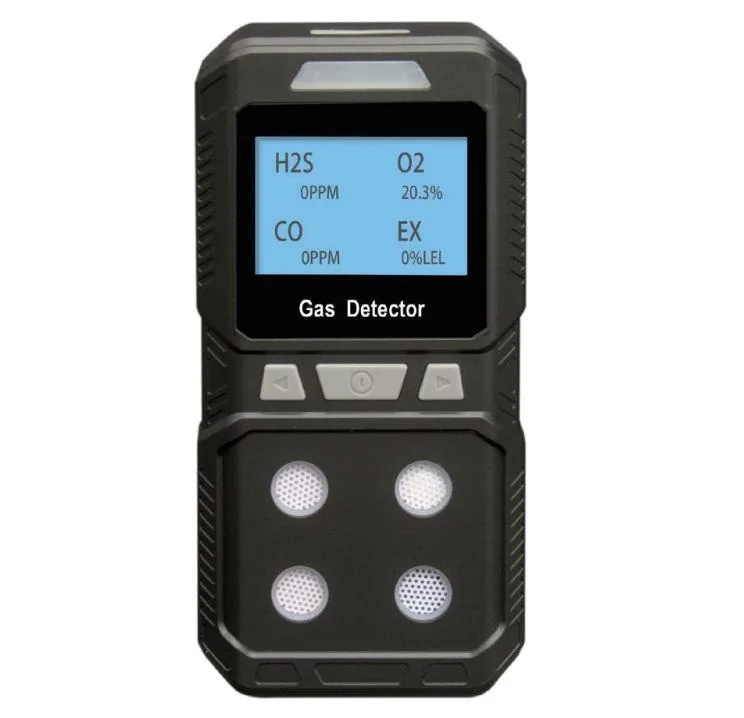
Black hand-held gas detector with a blue display reading H2S 0 ppm, O2 20.3 %, CO 0 ppm and EX 0 %LEL, the words Gas Detector printed below the screen, three buttons beneath the panel and four grilles for the sensing elements in the lower body

BH-4 / BH-90 · Portable Gas Detectors

Portable Gas Detector

Hand-held multi-gas and single-gas detectors with audible, visual and vibrating alarms, covering the four-gas confined space combination as standard and a long list of single gases to order.

Range
The BH-4 multi-gas instrument and the BH-90 single-gas instrument
Channels
Four on the BH-4, covering combustible gas, oxygen, hydrogen sulphide and carbon monoxide; one on BH-90
Display error
≤±5 %FS
Response time
T90 < 60 s
Orange flameproof gas detector in a round cast housing on a bracket, with a red beacon, a black antenna, a stainless steel sensing probe below the body, a digital display showing 8.8.8.8 and three small indicator labels below the display

GQ-KL800-L4 · Fixed Gas Detectors

Fixed Gas Detector

A point gas detector in an explosion-proof cast aluminium housing for continuous monitoring of combustible gas, oxygen, hydrogen sulphide and carbon monoxide, supplied as a stand-alone unit or with a controller over wired or wireless links.

Model
GQ-KL800-L4
Gases
Combustible gas, oxygen, hydrogen sulphide and carbon monoxide, with other gases available to order
Detection principle
Catalytic combustion for combustible gas; electrochemical cells for the toxic and oxygen channels
Explosion protection
Ex db IIC T6 Gb, flameproof
Portable ultrasonic thickness gauge in a black housing standing on a machined metal block in a workshop, its display reading 0.94 mm with a velocity line above it, a twelve-key control pad below showing eight colours of keys, a printed line reading ultrasonic thickness gauge, and a white-gloved hand holding the probe against the block

JITAI-510 / JITAI-515 / JITAI-512 / JITAI-514 · Ultrasonic Thickness Gauges

Portable Ultrasonic Thickness Gauge

Portable ultrasonic thickness gauge covering 0.8 to 600 mm, with through-coating, ultra-thin and electromagnetic variants down to 0.15 mm and 0.001 mm resolution.

Model
JITAI-510 / JITAI-515 / JITAI-512 / JITAI-514
Measuring range
0.8 to 600 mm on the JITAI-510 depending on probe; 1 to 300 mm for the through-coating model; 0.15 to 300 mm on the ultra-thin model; 0.75 to 160 mm on the electromagnetic model
Resolution
0.01 mm on the JITAI-510, 515 and 514; 0.001 mm on the JITAI-512
Accuracy
±0.05 mm between 0.8 and 10 mm and ±(0.01 + H/200) mm above 10 mm on the JITAI-510, where H is the measured thickness
Hand-held gas detector lying at an angle with a flexible metal gooseneck probe rising from its top, a display reading zero against the percentage of the lower explosive limit and naming the gas group, and a vertical row of three keys below it

JLY-CP100 / BT-JLY-CP100 · Gas Leak Detectors

Combustible Gas Leak Detector

Portable combustible gas leak detector reading 3 to 20 percent of the lower explosive limit with a flexible gooseneck probe, a three-way alarm and a full-colour display.

Detection range
3 to 20 percent of the lower explosive limit, with sub-ranges of 0 to 1000 ppm and 0 to 100 percent of the lower explosive limit
Alarm set point
10 percent of the lower explosive limit
Indication error
plus or minus 5 percent of the lower explosive limit
Gases
Methane, natural gas, biogas, hydrogen, coal gas, acetone, petrol and ethanol, with the material also naming oxides and sulfides and stating that organic combustible vapours from liquids such as petrol are detected
Digital ultrasonic flaw detector in a light grey housing with a large display showing an A-scan trace against a distance grid above a data panel listing gain, step, material, delay, zero, gate mode, average and reject values, a rotary knob and eleven control keys on the left, and five function keys marked BASE, CAL, DAC, AVG and SYS along the bottom

KUT350 / KY880S / KY990S / KY9901PLUS · Ultrasonic Testing Equipment

Digital Ultrasonic Flaw Detector

Digital ultrasonic flaw detector with 150 to 800 MHz sampling, DAC and AVG curves, 500 inspection channels and U-disk storage on the upper models, for weld, forging and plate inspection.

Model
KUT350 / KY880S / KY990S / KY9901PLUS
Sampling frequency
150 MHz / 200 MHz / 320 MHz / 800 MHz respectively
Scanning range
0 to 10000 mm on the KUT350; 0 to 6000 mm on the KY880S; 15 to 10000 mm on the KY990S; up to 15000 mm on the KY9901PLUS
Sound velocity
1000 to 15000 m/s on the KUT350 as the card figure, with 100 to 20000 m/s also printed on the same page; 100 to 15000 m/s and 100 to 20000 m/s on the upper models
Portable magnetic particle inspection yoke with a yellow and black body and a silver laminated pole piece, a coiled supply cable running to a separate black rectangular battery pack standing upright beside it

KY-CJE220 Series / Y Series / CDX-III · Magnetic Particle Testing Equipment

Portable Magnetic Particle Inspection Yoke

Portable magnetic particle inspection yoke with AC, DC and inverter power packs, white or ultraviolet illumination, and a 0 to 220 mm magnetising pole spacing, with a bench unit for small parts.

Model
KY-CJE220 series, Y series and the CDX-III bench unit
Magnetising pole spacing
0 to 220 mm on the portable range; 0 to 160 mm, 0 to 255 mm, 100 mm and Φ120 mm across the four bench probes
Detectable depth
3 mm below the surface on AC supply alone; 5 mm on the variants carrying a DC or inverter power pack
Lifting force
AC 45 N or better on the direct-supply yokes; AC 69 N and DC 215 N on the inverter model; the material also states AC 69 N and DC 215 N for the Y series
Four slim DIN-rail signal isolator modules standing side by side, each with pluggable terminals on the top face

M2 · Signal Isolators

DIN-Rail Signal Isolator

DIN-rail signal isolators and distributors giving 2000 Vrms isolation between input, output and supply, with 0.1%FS transmission accuracy and 10 ms response.

Isolation
2000 Vrms for 1 min, no flashover, between input, output and supply
Insulation resistance
100 MΩ minimum at 500 VDC
Transmission accuracy
0.1%FS at 20°C
Temperature drift
0.0075%FS/°C
Three stainless steel pressure transmitters side by side, one with a plug connector, one with a plug and tubular body, and one with a circular connector and cable gland

MIK-P300 · Pressure Transmitters

Configurable Pressure Transmitter

Diffusion silicon pressure transmitters built in a family of housings, from a plain plug version to sanitary, high-temperature, explosion-proof and 4G wireless forms, with 4-20 mA, voltage or RS-485 Modbus output.

Pressure ranges
-100 kPa to 60 MPa across the series
Pressure types
Gauge, absolute and sealed gauge
Accuracy
0.2, 0.25 or 0.5 grade, by range and configuration
Output
4-20 mA two-wire; 0-5 V, 1-5 V or 0-10 V three-wire; RS-485 with Modbus
Radar level meter with a blue cap over a stainless cylindrical housing carrying two cable entries and a cover screw, a black nameplate on the body, and a large stainless flange at the base drilled for bolts with a raised sealing face in the centre

MIK-RD908 / MIK-RD903 / MIK-RD701 · Radar Level Meters

80 GHz Radar Level Meter

Radar level meter in 80 GHz, low-frequency and guided-wave series for tanks, silos, rivers and pressurised vessels, with spans from 10 m to 80 m.

Model
Fourteen models across three series, from MIK-RD908 to MIK-RD702
Series
80 GHz high-frequency, low-frequency, and guided-wave
Range
0 to 10 m through to 0 to 80 m, according to series and model
Accuracy
±5 mm on the shortest spans through to ±30 mm at a 70 m span
A handheld calibrator in a black and grey body with a colour screen showing an output value, a measurement value and two trend traces, with coloured test leads above it and a row of function keys below

OHR-C01 / OHR-C02 / OHR-C03 · Temperature Calibrators

Handheld Temperature Calibrator

Handheld temperature calibrator that measures and sources thermocouple and resistance signals, with cold-junction compensation, step or ramp output and a colour trend display.

Models
A process loop version, a temperature-only version, and a multifunction version covering both
Thermocouple types
S, B, E, K, R, J, T and N, each with its own range and accuracy
Resistance elements
Pt100 and Cu50
Resistance ranges
0 to 400 ohm, 0 to 1,000 ohm and 0 to 10 kilo-ohm
Stainless steel pressure transmitter with a plug connector on top, a hex body and a threaded pressure port

TFD-801 · Pressure Sensors

Diffusion Silicon Pressure Transmitter

Diffusion silicon pressure transmitters with a 304 stainless steel body, IP65 sealing and ranges from -100 kPa to 100 MPa, in two-wire 4-20 mA and three-wire voltage forms.

Pressure ranges
-100 kPa to 100 MPa across the series
Pressure types
Gauge, absolute and sealed gauge
Accuracy
0.2%FS on the stocked ranges; a 0.5% grade is listed for the series
Output
4-20 mA two-wire as standard; 0-5 V, 0-10 V or RS-485 to order
Black cased circular pressure gauge with a white dial graduated to 1.6 MPa, a red tipped pointer and a brass threaded connection below the case

Y-60 / Y-100 · Pressure Gauges

Bourdon Tube Pressure Gauge

Bourdon tube pressure gauges in 60 mm and 100 mm dial sizes with brass connections, covering vacuum to 40 MPa on the 60 mm dial and offered across a wide range list on the 100 mm dial, in iron and stainless steel cases.

Dial sizes
60 mm (Y-60) and 100 mm (Y-100); a 150 mm size is named without a parameter table
Accuracy class
2.5 class on the 60 mm dial; 1.6 class on the 100 mm dial
Range, 60 mm dial
0-0.1 MPa up to 0-40 MPa in fourteen steps, plus -0.1-0 MPa vacuum
Range, 100 mm dial
0-0.1 MPa up to 0-60 MPa listed for the series, with compound and vacuum forms
Silver metal calibrator with a green LCD window above a row of membrane keys, a carrying handle, two large knurled knobs on the body and a transparent water cup on top

YPR-YBS-WY · Pressure Calibrators

Portable Pressure Calibrator

Battery-powered pressure calibrator with an integral hand pump, a 24 VDC loop supply and simultaneous pressure and current display, covering vacuum to 60 MPa including hydraulic ranges.

Pressure ranges
-95 kPa to 250 kPa; 0-1.6 MPa; 0-2.5 MPa; -95 kPa to 2.5 MPa; 0-4 MPa
Hydraulic ranges
0-16, 0-25, 0-40 and 0-60 MPa with the supplied water cup
Accuracy
0.05 grade basic; pressure 0.1%FS and 0.05%FS; current 0.05% ±1 digit
Resolution
10 Pa minimum pneumatically; 1 kPa minimum on the hydraulic ranges; 1 µA on current

Quoting for oil & gas

Send the process conditions and the standard you have to meet, and we will confirm the instrument, availability and documentation that can accompany the order.

Request for quotation

Request a quotation - Oil & Gas

Send the technical detail and we will confirm availability, lead time and terms. In-stock items ship within 48 hours; customized specifications typically take 2-10 days. Minimum order quantity is 1 pc.

The more of this you can give us, the fewer exchanges are needed before we can quote.
No file chosen
Datasheet, drawing, BOM or photograph. One file, up to 10 MB (PDF, Office, image or ZIP).

By submitting this form you agree that we may contact you about this enquiry. We do not sell or share enquiry data. See our privacy policy.

Items held in stock are dispatched within 48 hours of order confirmation. Customized specifications are produced to order and typically ship within 2 to 10 days. Transit time then depends on the shipping method and destination.

Request a Quote WhatsApp