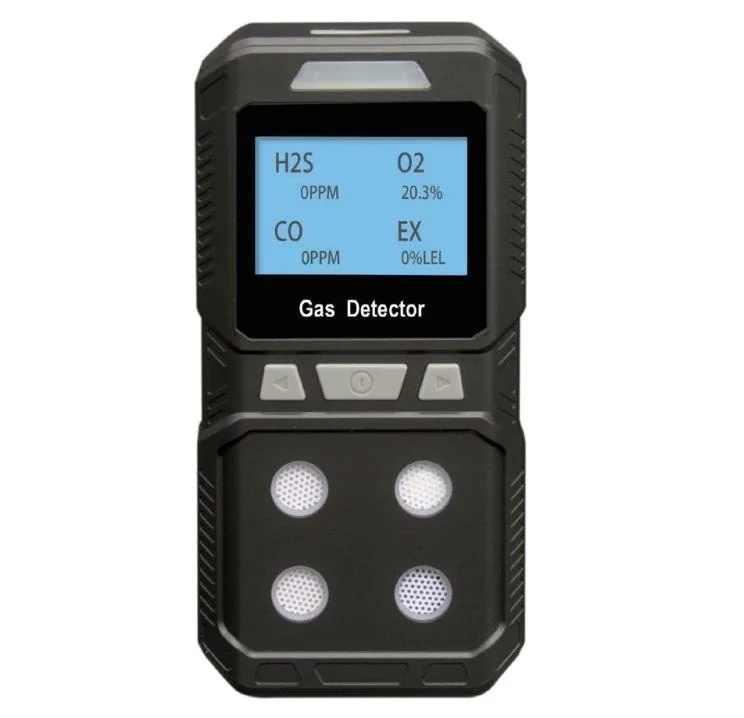
What a portable gas detector is
A portable gas detector is worn or carried by a person to warn them of a hazardous atmosphere before it affects them. Its purpose is protection in the moment, which distinguishes it from a fixed detection system that protects a plant: a portable instrument has to survive being dropped, run on a battery, and sound an alarm that the wearer cannot miss.
The duties it covers fall into a few recognisable groups. Oxygen deficiency and enrichment, flammable gas or vapour expressed as a fraction of the lower explosive limit, and toxic gases such as carbon monoxide and hydrogen sulphide form the classical four-gas combination for confined space entry. Other duties - a specific solvent vapour, carbon dioxide in a fermentation vessel, a refrigerant leak - call for a different sensor set, and the choice follows from a risk assessment rather than from habit.
A pumped instrument with a sampling line allows the atmosphere to be tested before anyone enters, which is the sequence confined space work requires. A diffusion instrument responds only to the atmosphere at its sensor, so it protects the wearer while they are inside but cannot survey the space beforehand. Which of the two fits depends on the procedure, and that is often the most consequential decision in the specification.
How a portable gas detector measures
Each gas uses a sensor technology suited to it, and knowing which is present matters because the technologies fail in different ways. A catalytic sensor burns a small amount of the gas on a heated element and measures the heat released, which suits flammable gas and reads the fraction of the lower explosive limit directly - but it needs oxygen to work and is poisoned by silicones, leaded compounds and some solvents. An infrared sensor absorbs light at a wavelength the gas absorbs, needs no oxygen and resists poisoning, and it cannot respond to hydrogen or to some light hydrocarbons. An electrochemical cell reacts the gas at an electrode and produces a small current proportional to concentration, which suits toxic gases and oxygen; cells deplete with exposure and have a finite life. A photoionisation detector ionises volatile organic compounds with ultraviolet light and gives a total reading without identifying the compound.
The measurement of flammable gas is expressed as a fraction of the lower explosive limit, and that figure depends on the gas. The same instrument responds differently to propane than to the methane it may have been calibrated on, because the response varies between gases and the calibration holds only for the one it was set to. Where a specific vapour is the hazard, the instrument is calibrated to that vapour, or the reading is corrected for it.
Oxygen is measured for two opposite reasons. A deficiency in a confined space can render a person unconscious without warning, which is why oxygen is measured alongside the toxic and flammable channels rather than treated as an optional extra. An enrichment, which can follow a leaking oxygen line or rusting steel in an enclosed space, raises the flammability of everything present instead. Both conditions are reported on the same channel, and both matter.
Configuration choices
Most of the specification is fixed by these decisions rather than by the accuracy class. Each one constrains the next, which is why they are settled in order.
| Configuration | Options to fix | What it actually decides |
| Sensor set and channel count | Single gas, or two, three or four channels in one instrument | Which hazards are covered at once, and how much a person has to carry to be protected against all of them. |
| Sensor technology per channel | Catalytic, infrared, electrochemical or photoionisation, chosen per gas | Whether the sensor responds to the specific hazard, and whether it will survive the atmosphere it is exposed to. |
| Sampling method | Diffusion, or a pump drawing the sample through a line | Whether the atmosphere can be tested before entry, which is what a confined space procedure normally requires. |
| Alarm arrangement | Audible, visual and vibrating alarms, and whether the levels are adjustable | Whether the warning is noticed in the conditions of use. A wearer in a noisy area or in heavy clothing may miss a sound and catch a vibration. |
| Battery and runtime | The runtime per charge, and whether the battery is replaceable | Whether the instrument covers a full shift, including the pre-entry sampling period. |
| Data logging | Whether readings, alarms and calibration events are recorded | Whether the record of an entry can be produced afterwards, which an investigation may require. |
| Durability and ingress protection | The drop rating and the ingress protection | Whether the instrument survives the work, which for something dropped on a steel deck is the difference between a usable tool and a liability. |
| Calibration station | Whether the instrument is calibrated in a docking station, and whether tests are recorded automatically | How much of the calibration discipline depends on a person remembering to do it, and how the evidence is stored. |
How to choose a portable gas detector
| Factor | Why it decides the answer | How to settle it before enquiring |
|---|
| Risk assessment of the space or the task | The hazards present decide which gases have to be measured, not a standard package | List the actual potential hazards, including anything the work itself could release. |
| Whether entry is involved | Confined space entry brings pre-entry testing and specific channel combinations with it | State whether the work is a confined space entry, and whether pre-entry testing forms part of the procedure. |
| The specific gases | A sensor is chosen per gas, and one technology will not cover a list of them | Name the gases, and say whether a flammable reading is wanted for a specific vapour or for any combustible. |
| Anything that would poison or disable a sensor | Silicones, leaded compounds, hydrogen sulphide and solvents damage particular sensors permanently | State what else may be present, beyond the gases that are to be measured. |
| Working conditions of the wearer | Noise, protective clothing, glove use, heat and the length of the shift all affect whether an alarm works | Describe the conditions, so the alarm and the runtime can be judged against them. |
| Record and procedure requirement | Entry permits and investigations may require evidence of calibration and of readings taken | State what has to be recorded, and for how long. |
| Local approval regime | An approval for use in a hazardous area may be imposed on the instrument itself | State the classification, and whether an approval certificate is required. |
If any of these are still open, send what is known. A quotation can be issued against a duty description and refined once the gaps are filled.
The nearest alternatives
These are the types an enquiry for a portable gas detector usually turns out to be, and the point at which the choice is genuinely decided.
| Nearest alternative | What separates it from a portable gas detector |
| Fixed gas detectors | Installed at a point where a gas would accumulate, wired into a control system and protecting a plant rather than an individual. They run continuously without attention and cover places a person would not carry an instrument into, but they cannot follow a wearer around a site. |
| Multi-gas detectors | A portable instrument carrying several channels at once, which is the usual configuration for confined space entry. The distinction from a single-gas device is coverage: the single-gas unit protects against the one hazard it was bought for and gives no indication of the others. |
| Single-gas detectors | Built around one hazard, usually as a small personal monitor worn throughout a shift. They are lighter and simpler, and they make no claim to cover a space in which more than one hazard is possible. |
| Gas leak detectors | Used to locate the source of a leak rather than to protect a person. The instrument is moved along a pipe run or around a fitting and the reading is interpreted as a gradient towards the leak, which is a different pattern of use from a personal alarm. |
| Combustible gas detectors | Concerned specifically with flammable gas and vapour, usually expressed as a fraction of the lower explosive limit. Where that is the only credible hazard, a dedicated instrument offers more options for that duty than a general four-gas monitor. |
| Oxygen gas detectors | Single-purpose instruments for oxygen deficiency or enrichment, used where oxygen is the only credible hazard - a cryogenic area, or a space served by an inert gas line. They answer a question the four-gas combination also answers, but with a much narrower focus. |
The decision that most often goes wrong is the sampling method. A diffusion instrument carried into a space cannot tell anyone what the atmosphere was before they entered it, and no amount of calibration changes that.
What to include in the enquiry
The first reply can be a quotation rather than a set of questions if the enquiry carries these. Where a figure is not known, send the duty description and we will confirm what it implies.
- The gases to be detected, from a risk assessment of the task or the space
- Whether the work involves confined space entry and pre-entry testing
- Whether a sample has to be drawn from a distance, or the instrument is worn
- What else may be present that could affect a sensor
- Shift length and the working conditions of the wearer
- Whether readings, alarms and calibrations must be recorded
- Area classification, and any approval required for the instrument
- Whether a calibration or docking station is wanted, and how many instruments it will serve
- Quantity, destination port and required delivery date