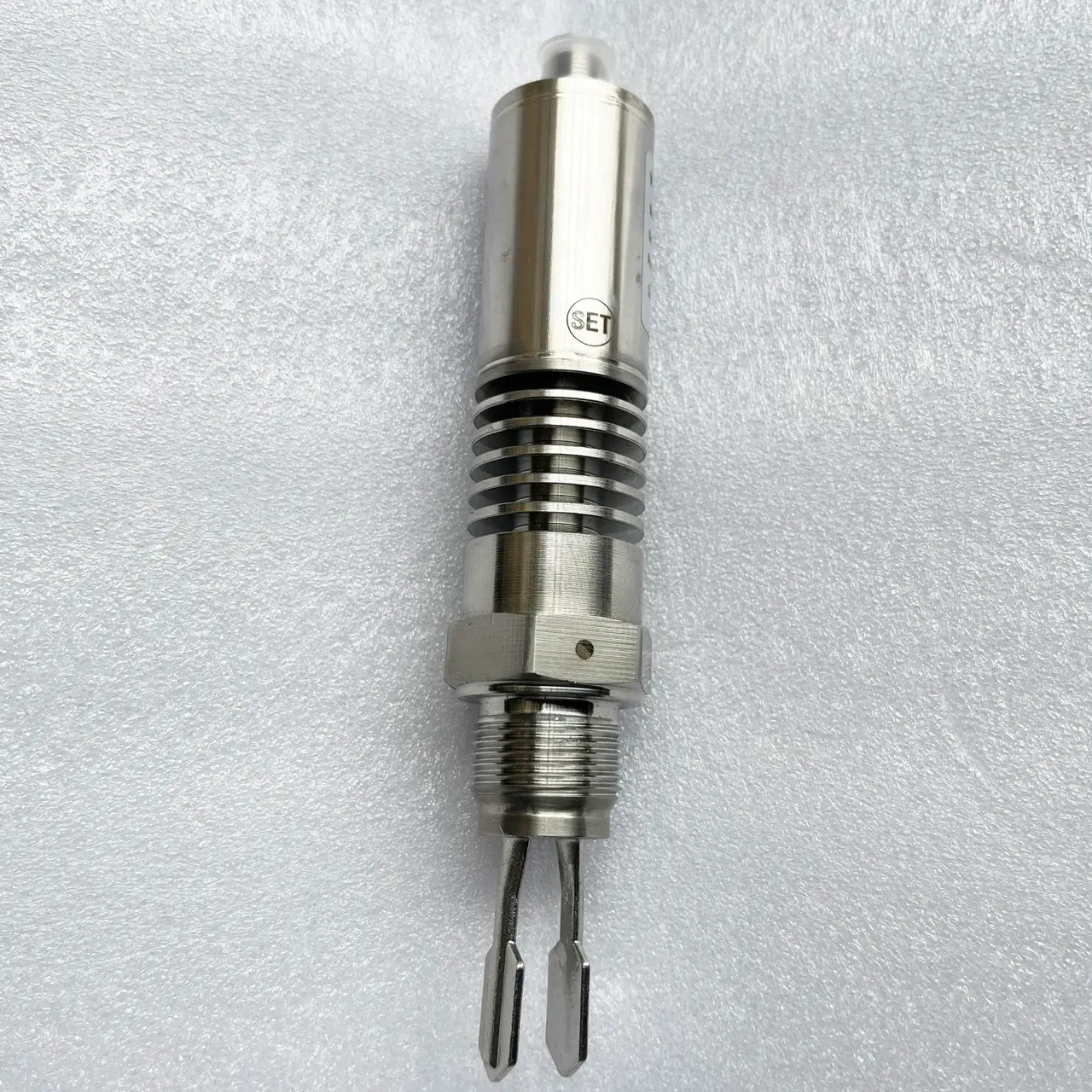
What a vibrating fork level switch is
A vibrating fork level switch answers one question: is the fork covered or not. It does not measure level over a range and it does not send a value; it changes the state of a contact when the medium reaches it. For a pump cut-out, a high-level alarm or a dry-run protection, that is the whole requirement.
The boundary against its neighbours follows from that. A level transmitter reads the level continuously and is chosen when the level itself has to be known. A float switch also gives a contact, but it has a moving part and a gap that a coating or a solid can bridge. A capacitive or conductive probe gives a contact without moving parts, but it depends on the medium’s electrical properties. The fork depends on density and viscosity instead, which is why it is the usual answer for slurries and viscous liquids.
What decides the choice is therefore not the electronics but the medium and the mounting: whether it is heavy enough to shift the fork frequency, whether it will coat the tines, and whether the nozzle gives the fork room to sit clear of the wall.
How a vibrating fork level switch measures
The fork vibrates at its resonant frequency in air. When the medium covers it, the added mass lowers that frequency, and the electronics detect the shift and change the output state. When the medium falls away, the frequency returns and the output changes back.
Three practical consequences follow. There is no moving part to jam and no narrow gap for solids to bridge, so a slurry that would defeat a float passes the fork without effect. The switch needs no calibration to a level, because it is not measuring level; it is detecting coverage. And it needs a minimum density, because a medium too light to shift the frequency will not be detected - which is the figure most often missing from a quotation.
The output is a contact or a transistor, not an analogue value. A relay drives a contactor or an alarm directly; a PNP or NPN pair suits a PLC input; a bus output suits a plant that reads several instruments over one network. The choice is decided by what the signal is connected to rather than by the switch.
Configuration choices
Most of the specification is fixed by these decisions rather than by the accuracy class. Each one constrains the next, which is why they are settled in order.
| Configuration | Options to fix | What it actually decides |
| Medium density and viscosity | The lightest medium the fork must detect, and how thick it is | Whether the switch works at all. A fork that vibrates freely in water may not shift enough in a light powder or a foam, and a very viscous medium can damp the fork regardless of density. |
| Process pressure and temperature | The pressure at the nozzle, and the temperature at the fork | Which construction is needed. The pressure rating is a property of the body; the fork temperature is a property of the medium, and the housing stays cooler only because of the heat-break section between them. |
| Output | A relay contact, a transistor pair, or a bus output | What the switch can drive. A relay suits a contactor or an alarm; a transistor suits a PLC input; a bus suits a network. The control system decides this. |
| Mounting and insertion length | A thread or a flange, and how far the fork must reach into the vessel | Whether the fork sits clear of the nozzle wall and clear of the inlet stream. A fork that is too short reads the nozzle rather than the vessel, and one that is too long can be struck by an agitator. |
How to choose a vibrating fork level switch
| Factor | Why it decides the answer | How to settle it before enquiring |
|---|
| Lightest medium to be detected | It sets whether the fork shifts frequency at all, and it is the one figure that cannot be corrected after installation. | Give the medium, its density and whether it foams or aerates. |
| Whether the medium coats | A coating that bridges the tines damps the vibration and can hold the switch in one state. | Say whether the medium crystallises, polymerises or leaves a film, and whether a coated fork is acceptable. |
| Nozzle and insertion depth | The fork has to sit clear of the wall and of the inlet stream, and the insertion length follows the nozzle. | Send the nozzle drawing rather than the pipe size alone. |
| What the contact drives | A relay, a transistor and a bus output are not interchangeable, and the control system decides which is needed. | Say what the output is connected to, and the voltage and current it switches. |
The nearest alternatives
These are the types an enquiry for a vibrating fork level switch usually turns out to be, and the point at which the choice is genuinely decided.
| Nearest alternative | What separates it from a vibrating fork switch |
| Level switches | The general family, including float, capacitive, conductive and paddle types. The fork is chosen where the medium would jam a float or bridge a probe gap; the other types are chosen where density is too low for a fork or the medium is clean. |
| Hydrostatic level transmitters | Reads level continuously from the pressure at the bottom of the vessel. Gives a number rather than a contact, and needs the vessel height and the liquid density to be known. |
| Ultrasonic level transmitters | Non-contact measurement from the top of the vessel. Suits a tank where nothing may enter the medium, but is affected by foam, vapour and the shape of the vessel in a way a fork is not. |
| Radar level transmitters | Non-contact measurement that tolerates vapour and pressure better than ultrasonic. Chosen where a continuous reading is needed in a difficult atmosphere rather than a point switch. |
A switch and a transmitter are often mounted on the same vessel: the transmitter for the reading and the switch for the independent high-level alarm.
What to include in the enquiry
The first reply can be a quotation rather than a set of questions if the enquiry carries these. Where a figure is not known, send the duty description and we will confirm what it implies.
- Medium, its density and whether it foams, aerates or coats
- Pressure and temperature at the nozzle
- Process connection: thread or flange, size and standard
- Insertion length, or the nozzle drawing
- Output required and what it is connected to
- Supply available on site
- Whether the area is classified as hazardous
- Quantity, destination port and required delivery date