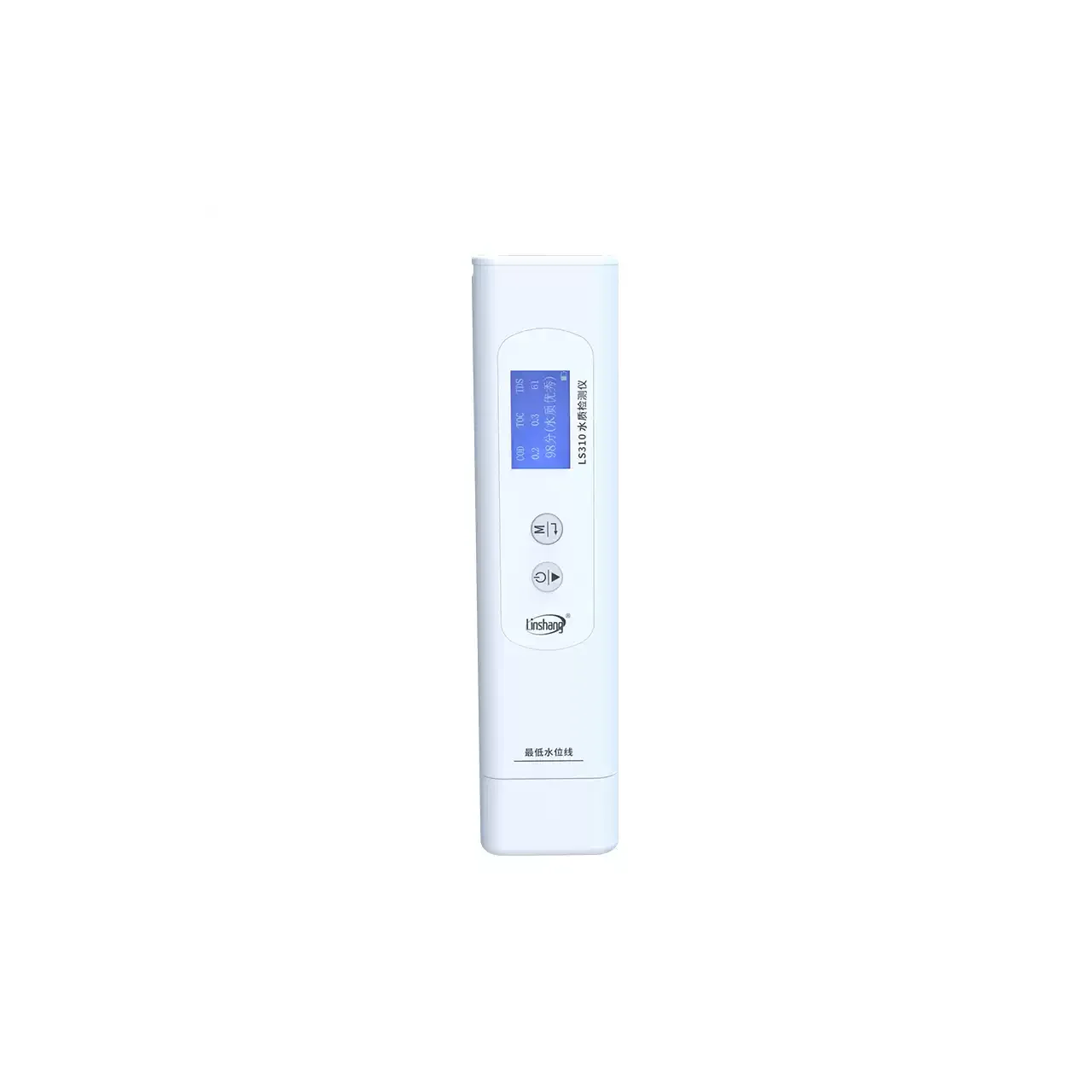
What a water quality analyzer is
A water quality analyzer measures several of the parameters used to judge a water sample in one instrument: acidity or alkalinity, oxidation-reduction potential, conductivity, dissolved oxygen, turbidity, ion concentration and temperature. In this catalogue the type is the multi-parameter instrument - a meter with several inputs and a set of electrodes - rather than the single-parameter analyzer installed on a pipe.
The reason to combine them is the sample rather than the electronics. Several parameters read from the same water at the same moment can be compared with each other, and a reading that moves with temperature or with time since sampling is at least moving under the same conditions. Separate meters give a set of numbers from a set of moments, which is adequate for a trend and weak as a record.
Combining also has a cost. The electrodes remain separate sensors with separate maintenance, and the reference junction they share in some formats is the part most likely to drift. What decides the configuration is which parameters the method names, whether they must be read simultaneously at one point, how dirty the water is, and whether the result is a spot check or a logged survey. This page covers those choices and the boundary against the single-parameter analyzers.
How a water quality analyzer measures
Each parameter has its own sensing chemistry and its own signal. Acidity and redox potential are potentiometric: a membrane develops a voltage against a reference, and the instrument measures that voltage with a very high input impedance. Conductivity is a cell with a known geometry, driven with an alternating current so that the electrodes do not polarise, and corrected for temperature. Dissolved oxygen is a membrane-covered electrochemical cell or an optical sensor whose luminescence is quenched by oxygen. Turbidity is scattered light. The instrument is a multi-input front end with a different computation behind each channel.
The reference electrode is the shared weakness. Potentiometric channels depend on a stable reference and a liquid junction that stays wet and open; a dried or blocked junction shifts every channel that uses it, and the shift may look like a real change in the water. Where a combined electrode carries more than one sensor, a fault in the shared body affects all of them at once, which is convenient to use and harder to diagnose.
Temperature is measured separately and used to compensate, so its location matters. If the temperature element sits in a different probe from the parameter it corrects, or in a different part of the sample, the compensation is applied to a temperature the sensor did not see. Calibration is also per channel: each parameter has its own standard or buffer, its own slope and its own record. A multi-parameter meter does not calibrate as one instrument, and a certificate that names one parameter says nothing about the others.
Configuration choices
Most of the specification is fixed by these decisions rather than by the accuracy class. Each one constrains the next, which is why they are settled in order.
| Configuration | Options to fix | What it actually decides |
| Parameter set | Which of the available channels are fitted, and whether the meter accepts additional electrodes later | What the instrument can report, and what still has to be measured elsewhere or by a second instrument. |
| Electrode format | Separate probes on cables, a combined electrode carrying several sensors, or a single sonde with all of them | How many dips a sample takes, and whether all readings come from the same point at the same moment. |
| Temperature element | Built into one of the electrodes, separate, or built into the meter | Whether the compensation is applied at the temperature the sensor actually experiences. |
| Reference arrangement | A refillable reference, a gel reference, or a shared junction in a combined electrode | How much maintenance the meter needs, and how a drifting reference will show up across channels. |
| Calibration provision | Automatic buffer recognition, stored calibration records, and the number of points per parameter | Whether the calibration can be repeated the same way by different operators, and whether it leaves a record. |
| Reading mode | Simultaneous display of all channels, or sequential selection of one at a time | Whether a set of values can be captured at one moment, which is the reason for combining them. |
| Storage and interface | Internal memory with a sample identity, a serial or wireless link, and the export format | Whether a survey becomes a file that can be compared with another, or a set of numbers on paper. |
| Housing and power | A bench case, a portable case with a battery, and the ingress protection of the probe connections | Whether the meter is used in a laboratory, in a plant room or at a sampling point outdoors. |
How to choose a water quality analyzer
| Factor | Why it decides the answer | How to settle it before enquiring |
|---|
| The parameters the method names | It fixes the channel set, and a parameter without a channel cannot be added by software | List the parameters and the range of each, not only their names. |
| Whether the readings must be simultaneous | A combined sonde gives one moment; separate probes give a sequence | Say whether the values are compared with each other or only with their own limits. |
| The condition of the water | Fouling, turbidity and ionic strength affect the electrodes and the maintenance interval | Describe the sample, and whether it is clean, dirty, salty or heavily organic. |
| Where the measurement is taken | A laboratory bench, a plant room or a field sampling point | State the power available, and whether the meter has to be carried. |
| Whether a record is needed | Logging and sample identity turn readings into evidence | Say whether the results are transcribed or exported, and in what format. |
| Who performs the calibration | The calibration routine and the buffer set have to match the skill and the routine on site | Describe who will calibrate, how often, and whether a record is kept. |
| Whether continuous control is required | A portable meter is a spot check; a loop needs an installed analyzer | State whether the value drives a dosing pump or a control system, which puts the job outside this type. |
If any of these are still open, send what is known. A quotation can be issued against a duty description and refined once the gaps are filled.
The nearest alternatives
These are the types an enquiry for a water quality analyzer usually turns out to be, and the point at which the choice is genuinely decided.
| Nearest alternative | What separates it from a multi-parameter meter |
| Conductivity analyzers | An installed, single-parameter instrument that measures one channel continuously and drives an output. The multi-parameter meter takes a spot reading; it does not replace a control loop, and its cell is not built for continuous immersion. |
| pH analyzers | Continuous measurement of one parameter with its own reference and transmitter, installed where the process is. The portable meter is used to check and calibrate against it, which is a different duty from controlling with it. |
| Dissolved oxygen analyzers | An installed sensor with a defined flow past its membrane and a transmitter behind it. A portable meter reads the sample as it is presented, so stirring and depth change the figure, which is why the two are not compared without the sampling method. |
The multi-parameter meter answers what the water is like at the moment of sampling. The single-parameter analyzers answer what it is doing continuously. A site usually needs both, and neither reading validates the other without a sampling procedure.
What to include in the enquiry
The first reply can be a quotation rather than a set of questions if the enquiry carries these. Where a figure is not known, send the duty description and we will confirm what it implies.
- The parameters and the range of each
- Whether the readings have to be simultaneous at one point
- The condition of the water, and the fouling it is likely to cause
- The environment and the power available
- Whether results are logged or exported, and how the meter is calibrated
- Quantity, destination port and required delivery date