Electrical Test & Measurement · Electrical Safety Testers

Adjustable AC/DC Withstand Voltage Tester

Adjustable hipot tester series with 0 to 5 kV and 0 to 10 kV outputs, leakage ranges to 500 mA, presettable test time and optional PLC control.

LK2670AX (6 models) ·

Key specifications

Output voltage
0 to 5 kV AC or AC/DC on the 5 kV models; 0 to 10 kV AC or AC/DC on the 10 kV models; 0 to 3 kV DC on LK2673C
Leakage current ranges
0 to 2 mA or 20 mA; 100 mA, 200 mA and 500 mA ranges on the higher-current models
Accuracy
±(5% + 3 counts) across the series
Test time
1 to 99 s as standard, 1 to 999 s on LK2672C+ and available as a custom setting
Output capacity
100 VA to 2500 VA depending on model
Display
Three LED digit groups for test time, leakage current and voltage
Alarm
Upper leakage limit presettable, with an over-leakage lamp and a long audible tone
Control
Manual start and reset on the panel; PLC interface optional across the series
Protection
Voltage breakdown protection
Accessory
LK26001 high-voltage test probe supplied with every model

A hipot test is a stress test with a number attached, and the number only means something if the operator can see the voltage that produced it. The instruments in this series put time, leakage current and applied voltage on three separate displays at once, and leave the voltage on a continuous control rather than a set of fixed taps.

Product overview

Thirteen models share one control layout across three voltage groups: 0 to 5 kV, 0 to 3 kV direct, and 0 to 10 kV. Within each group the differences are whether a direct output is fitted, how much leakage current the instrument can supply, and how much output capacity the transformer behind it has.

The bodies run from an 8 kg bench case to a 45 kg floor-standing unit. The 5 kV models split into a 100 VA entry pair, a 500 VA group, a 1000 VA group and a single 2500 VA model, so the same panel can be specified for a bench testing small assemblies or for a station testing large equipment.

How the withstand voltage tester works

The instrument steps up the mains supply to an adjustable high voltage and applies it between the item’s live parts and its accessible metalwork, or between the two sides of an insulation barrier. The current that flows is the leakage current, and it is displayed while the voltage is held.

A good insulation draws a small current that rises slowly with voltage and with capacitance. A failing one draws a current that rises sharply as the insulation breaks down, which is what the upper limit is set to catch. When the limit is exceeded the instrument lights the over-leakage lamp, sounds a long tone and, on breakdown, cuts the output.

The direct output works the same way except that it charges the item’s capacitance before the reading settles, which is why a direct test reports the leakage that remains after charging rather than the total current including it.

How to select the right withstand voltage tester

The test voltage comes first. Five kilovolts covers appliances, information technology equipment and most mains-powered assemblies; ten kilovolts is for medium-voltage components and thicker insulation; the 3 kV direct model is for capacitors and semiconductor devices that are tested in the blocking direction.

The second question is leakage current. Twenty milliamps suits small products; 100 mA suits appliances with larger capacitance or longer leads; 200 mA and 500 mA suit equipment where a good sample already draws more than a hundred milliamps. Choosing a range that is too low produces failures on good products, which is the most common commissioning problem with a hipot tester.

Output capacity follows the leakage. A 100 VA transformer cannot hold five kilovolts into a load that draws 100 mA, so the capacity figure, not the voltage figure, decides whether the instrument can run the test at all.

The last question is the fixture. The PLC interface is optional across the series, so a station that will be started by a controller needs it specified at the order, and the probe set should be matched to the terminal arrangement rather than left at the standard one.

Measurement limitations and selection considerations

The instrument displays the total current through the item, which includes the current through the test leads, the probe and any fixture between them. On a product with low leakage that stray capacitance can be a large part of the reading, so the limit has to be set with the fixture connected and characterised.

The voltage is adjustable by hand, which means the rate of rise depends on the operator. A standard that specifies a controlled ramp needs either a motorised or programmable source, or a written procedure that fixes the time taken to reach the test voltage.

The 5 kV and 10 kV figures are open-circuit outputs. Into a load that draws a high current the instrument reaches its capacity limit before it reaches its voltage limit, and the two figures have to be read together.

Finally, a hipot test says nothing about the resistance of the protective bond or about the power the product consumes. A product that needs those checks needs a ground bond tester or a power meter as well, not a higher voltage setting on this instrument.

Features

  • Output voltage is continuously adjustable from zero, so the rate of rise is under the operator’s control rather than fixed by the instrument
  • Leakage current is presettable at the upper limit, and the instrument reports an over-leakage condition with a lamp and a long audible tone rather than a reading alone
  • Three separate LED groups show time, leakage current and voltage at the same time, so the operator sees the applied voltage and the current it produces without switching displays
  • Test time can be preset and is stopped by the instrument at the end of the interval, which keeps a manual test from being held too long
  • Direct output models reach capacitor leakage, high-voltage rectifier reverse voltage and transistor reverse current, which an alternating output cannot test
  • The 500 mA and 200 mA models carry the leakage of larger equipment, where a 20 mA instrument would trip on a good sample
  • A PLC interface is available across the series, so the instrument can be started and reset from a fixture controller rather than by hand

Technical specifications

Every value below is taken from source documentation. Where a parameter is not stated in the available material it is marked as information required rather than estimated.
Output
Output voltage, LK2670AX0 to 5 kV ACStandard
Output voltage, LK2672X0 to 5 kV AC or DCStandard
Output voltage, LK2672B and LK2672C0 to 5 kV AC on LK2672B; 0 to 5 kV AC or DC on LK2672CStandard
Output voltage, LK2672C+ and LK2672DX0 to 5 kV AC or DCStandard
Output voltage, LK2672D and LK2672D+0 to 5 kV AC; the parameter table also reads AC or DC for LK2672D+Information required
Output voltage, LK2672E0 to 5 kV ACStandard
Output voltage, LK2673C0 to 3 kV DC; the parameter table reads AC for the same rowInformation required
Output voltage, LK2671B and LK2671C0 to 10 kV AC or DCStandard
Output voltage, LK2671D0 to 10 kV ACStandard
Output capacity100 VA on LK2670AX and LK2672X; 500 VA on LK2672B, LK2672C, LK2672C+ and LK2671B; 1000 VA on LK2672D, LK2672D+, LK2672DX and LK2671D; 2500 VA on LK2672E; 300 VA on LK2673CStandard
Output capacity, LK2671C500 VA in the parameter table, 1000 VA in the same table and on the model cardInformation required
Leakage current
Range, LK2670AX and LK2672X0 to 2 mA or 0 to 20 mAStandard
Range, LK2672B0 to 2, 20 or 100 mA, ACStandard
Range, LK2672C and LK2672C+0 to 2, 20 or 100 mA AC; 0 to 2 or 20 mA DCStandard
Range, LK2672D and LK2672D+0 to 2, 20 or 200 mA ACStandard
Range, LK2672DX0 to 2, 20 or 200 mA AC; 0 to 2 or 20 mA DCStandard
Range, LK2672E0 to 2 or 500 mA ACStandard
Range, LK2673C0 to 2, 20 or 100 mA, marked DC on the model card and AC in the parameter tableInformation required
Range, LK2671B0 to 2 or 20 mA AC; 0 to 2 or 10 mA DCStandard
Range, LK2671C0 to 2, 20 or 100 mA AC; 0 to 2 or 10 mA DCStandard
Range, LK2671D0 to 2, 20 or 500 mA ACStandard
Accuracy±(5% + 3 counts) on every modelStandard
Control and timing
Test time1 to 99 s as standard; 1 to 999 s on LK2672C+Standard
Timing actionThe set interval starts with the timer switch and stops the output when it expiresStandard
Start and resetManual keys on the front panel, with a remote input for external start and resetStandard
PLC interfaceOptional on every model, for external start and reset from a controllerOptional
Upper leakage limitPresettable on the front panel; exceeding it lights the over-leakage lamp and sounds a long toneStandard
Breakdown protectionOutput is cut when the item breaks downStandard
Installation
Dimensions, LK2670AX and LK2672X350 × 135 × 280 mmStandard
Dimensions, LK2672B and LK2672C375 × 195 × 280 mm in the parameter table and 370 × 195 × 280 mm in the selection tableInformation required
Dimensions, LK2672C+ and LK2673C370 × 195 × 280 mmStandard
Dimensions, LK2672D, LK2672D+ and LK2672DX370 × 195 × 340 mmStandard
Dimensions, LK2672E500 × 400 × 880 mmStandard
Dimensions, LK2671B370 × 195 × 280 mmStandard
Dimensions, LK2671C370 × 195 × 280 mm in the selection table and 370 × 195 × 340 mm in the parameter tableInformation required
Dimensions, LK2671D650 × 450 × 800 mmStandard
Weight8 kg on LK2670AX; 10 kg on LK2672X; 12 kg on LK2672B, LK2672C, LK2672C+ and LK2673C; 20 kg on LK2672D, LK2672D+ and LK2671B; 25 kg on LK2672DX and LK2671C; 30 kg on LK2672E; 45 kg on LK2671DStandard
Operating environment0 to 40 °C, 75% RH or belowStandard

Available models

Selection table
Model Configuration Key ranges Availability
LK2670AX 5 kV AC, 20 mA, 100 VA 0 to 5 kV AC; 0 to 2 or 20 mA; 1 to 99 s The entry model for small appliances and assemblies
LK2672X 5 kV AC/DC, 20 mA, 100 VA 0 to 5 kV AC or DC; 0 to 2 or 20 mA; 1 to 99 s The entry model with a direct output
LK2672B 5 kV AC, 100 mA, 500 VA 0 to 5 kV AC; 0 to 2, 20 or 100 mA; 1 to 99 s Higher current for larger equipment
LK2672C 5 kV AC/DC, 100 mA AC and 20 mA DC, 500 VA 0 to 5 kV AC or DC; 1 to 99 s The model shown in the supplied photograph
LK2672C+ 5 kV AC/DC, 100 mA AC and 20 mA DC, 500 VA 0 to 5 kV AC or DC; 1 to 999 s The long timing setting in the 500 VA body
LK2672D 5 kV AC, 200 mA, 1000 VA 0 to 5 kV AC; 0 to 2, 20 or 200 mA; 1 to 99 s For equipment that draws more leakage
LK2672D+ 5 kV AC, 200 mA, 1000 VA 0 to 5 kV AC; 0 to 2, 20 or 200 mA; 1 to 99 s Listed as AC in the selection table and AC/DC in the parameter table
LK2672DX 5 kV AC/DC, 200 mA AC and 20 mA DC, 1000 VA 0 to 5 kV AC or DC; 1 to 99 s The full-function 200 mA model
LK2672E 5 kV AC, 500 mA, 2500 VA 0 to 5 kV AC; 0 to 2 or 500 mA; 1 to 99 s The largest output in the 5 kV group
LK2673C 3 kV DC, 100 mA, 300 VA 0 to 3 kV; 0 to 2, 20 or 100 mA; 1 to 99 s Direct output with a high-current discharge function
LK2671B 10 kV AC/DC, 20 mA AC and 10 mA DC, 500 VA 0 to 10 kV AC or DC; 1 to 99 s The entry model of the 10 kV group
LK2671C 10 kV AC/DC, 100 mA AC and 10 mA DC, 500 VA 0 to 10 kV AC or DC; 1 to 99 s The higher-current 10 kV model
LK2671D 10 kV AC, 500 mA, 1000 VA 0 to 10 kV AC; 0 to 2, 20 or 500 mA; 1 to 99 s The largest output in the range

Customization

  • Test time extended to 1 to 999 s
  • PLC interface fitted for start and reset from a fixture controller
  • Test probes and lead sets for a particular terminal arrangement

Certification and compliance

Certification documents not yet supplied

Certifications are only published once a certificate copy can be produced, so this section is deliberately empty rather than populated with assumed approvals. Tell us which approvals your application requires and we will confirm what is available for this instrument.

Parameters still to be confirmed

The following are required for a complete specification but are not stated in the documentation supplied to us. They are listed rather than estimated:

  • Whether LK2673C has an alternating or a direct output, since the model card and the selection table say DC and the parameter table row says AC
  • The output capacity of LK2671C, given as 500 VA in one merged cell of the parameter table, 1000 VA in the next cell of the same table, and 1000 VA on the model card
  • Whether LK2672D+ has a direct output, since the selection table says AC and the parameter table says AC/DC
  • The body dimensions of LK2672B and LK2672C, given as 375 × 195 × 280 mm in the parameter table and 370 × 195 × 280 mm in the selection table
  • The body dimensions of LK2671C, given as 370 × 195 × 280 mm in the selection table and 370 × 195 × 340 mm in the parameter table
  • The test time of LK2672C+, given as 1 to 999 s in the parameter table and 1 to 99 s on the model card
  • Whether the 1 to 999 s timing is a factory option on all models or standard on one
  • Calibration certificate availability and the standard it would be issued against
  • Warranty period and its terms
  • Duty cycle for repeated tests at 500 mA and at 10 kV
  • Ingress protection rating, which the material does not state

Frequently asked questions

When is a direct output needed instead of an alternating one?

When the item has a capacitor, a rectifier stack or a semiconductor junction that has to be stressed in the direction it blocks. A direct test charges the capacitance and then measures the leakage that remains, which is the quantity those components are specified by. An alternating output would pass charging current continuously and tell you much less about the insulation.

Which model suits a product that draws 150 mA of leakage?

LK2672D, LK2672D+ or LK2672DX, whose alternating ranges reach 200 mA. The 100 mA models would trip on a good sample at that current, and the 20 mA models are well below it. Among the three, the DX adds a direct output for the same 1000 VA body.

What has to be confirmed before a quotation?

The test voltage from the product standard, which decides between the 5 kV, 3 kV DC and 10 kV groups; the leakage current a good sample draws, which decides the current range and the output capacity; whether a direct test is needed; and whether the fixture will start the instrument from a PLC. Probe type and lead length should also be stated, since one probe set is the only accessory listed.

Related products

Other models in the same range

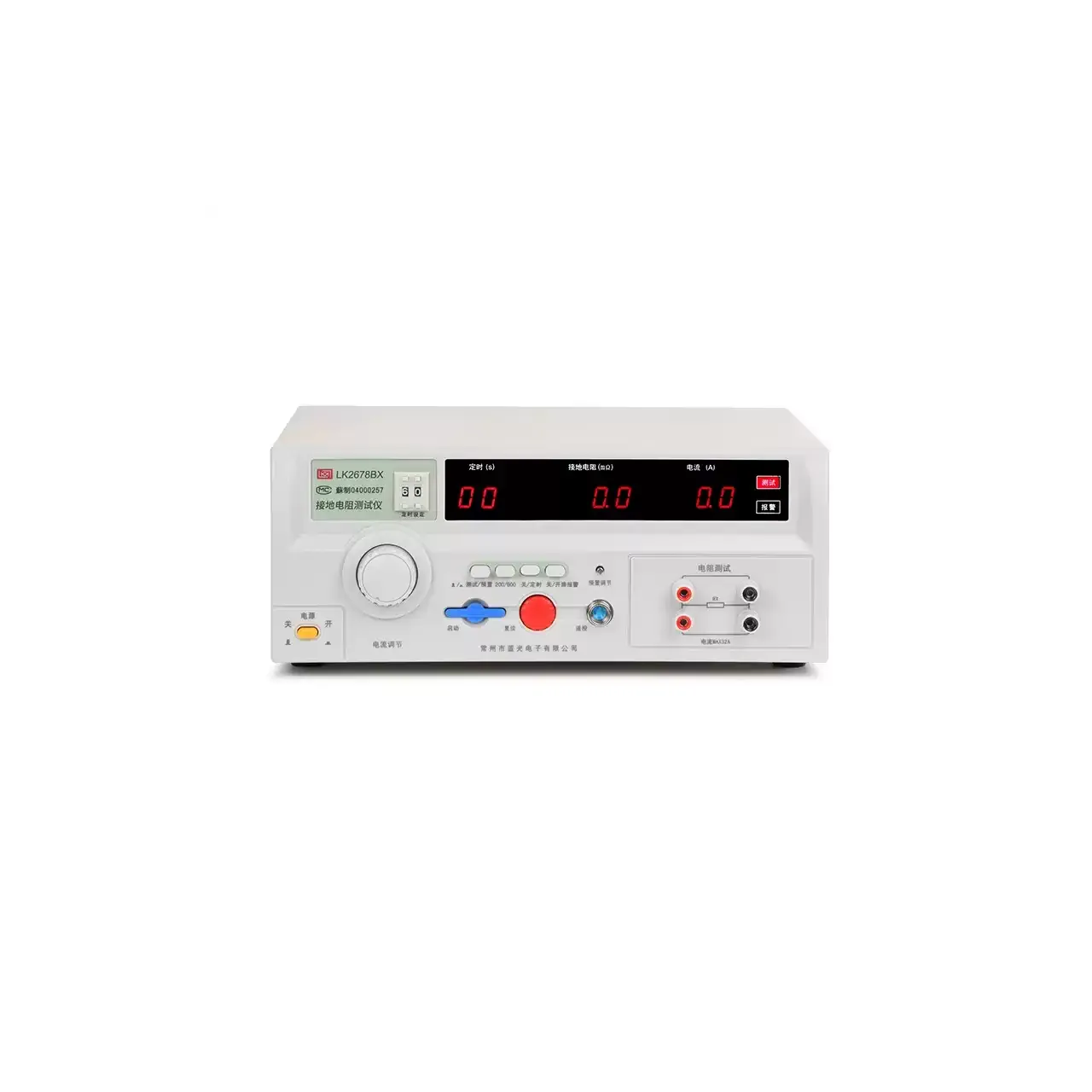
Off-white benchtop tester seen from the front, with a large grey current knob at the left, a black display strip carrying three red digital readouts across the centre, a row of small keys below it and two pairs of red and black terminals on a separate panel at the right

LK2678BX (4 models) · Electrical Safety Testers

Four-Wire Ground Bond Resistance Tester

Four-terminal ground bond tester with 1 to 50 A output across four models, 0 to 600 mΩ ranges, presettable test time and upper limit alarm.

Output current
5 to 32 A on LK2678BX, 10 to 50 A on LK2678, 3 to 32 A on LK7305, 0.01 to 45 A on LK7340
Resistance range
0 to 200 mΩ or 0 to 600 mΩ on LK2678BX and LK2678; 0 to 510 mΩ on LK7305; 0 to 600 mΩ on LK7340
Resistance accuracy
±5% on LK2678BX and LK2678; ±2% on LK7305 and LK7340
Test time
1 to 99 s on LK2678BX, 1 to 999 s on LK2678, 0.1 to 999.9 s on LK7305, 0 or 0.5 to 999.9 s on LK7340
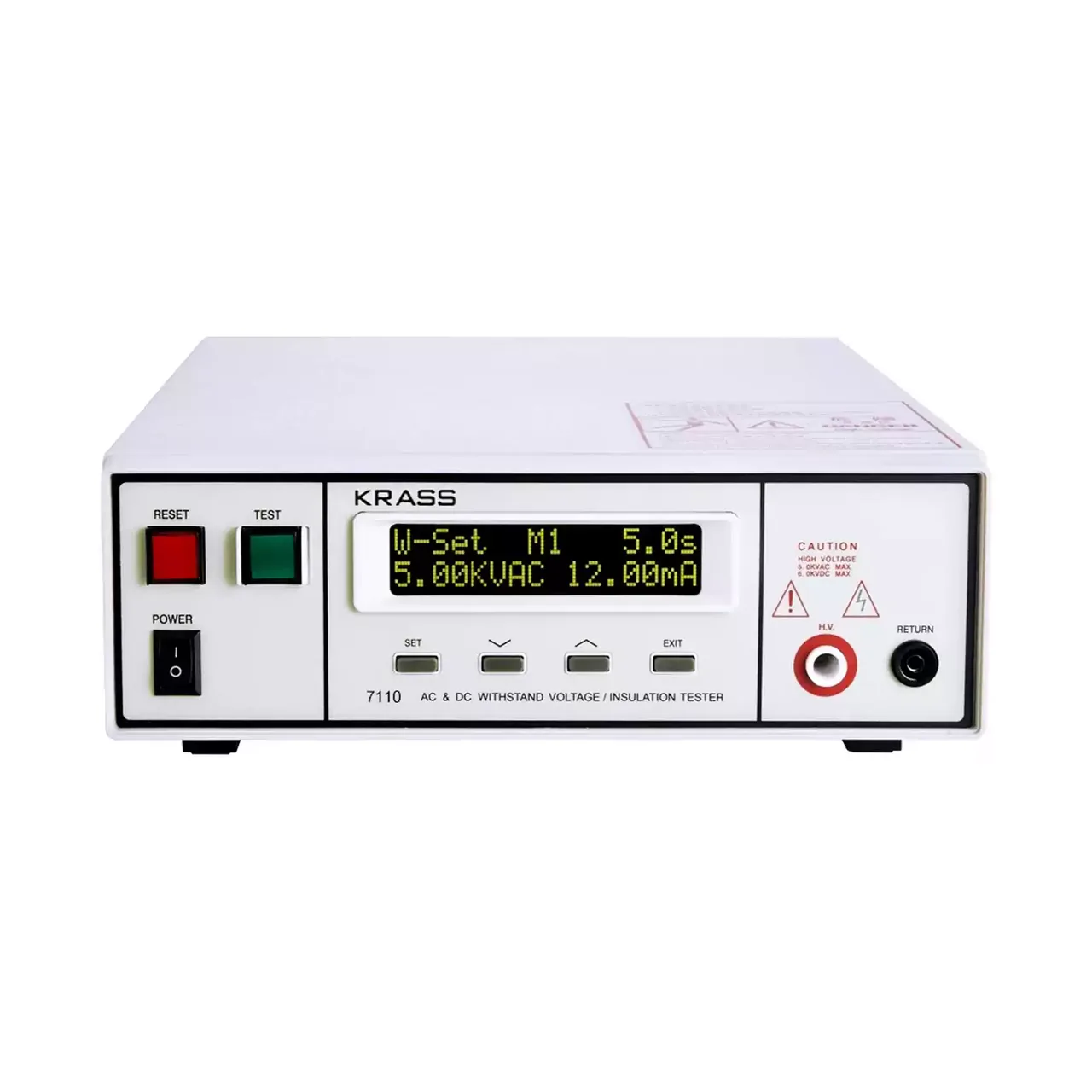
Compact programmable safety tester shown from the front with the two-line LCD at the upper left, a row of function keys beneath it and the test terminals along the lower right

7110 (8 models) · Electrical Safety Testers

Compact AC/DC Withstand Voltage and Insulation Tester

Compact programmable safety tester with 5 kV AC and 6 kV DC withstand voltage, insulation resistance to 9999 MΩ, five stored programs and PLC remote control.

AC output
0 to 5.00 kV, 12 mA
DC output
0 to 6.00 kV, 5 mA, on four of the eight models
Frequency
50 or 60 Hz, selectable
Leakage limits
0.10 to 12.00 mA AC and 0.02 to 5.00 mA DC, upper and lower set independently
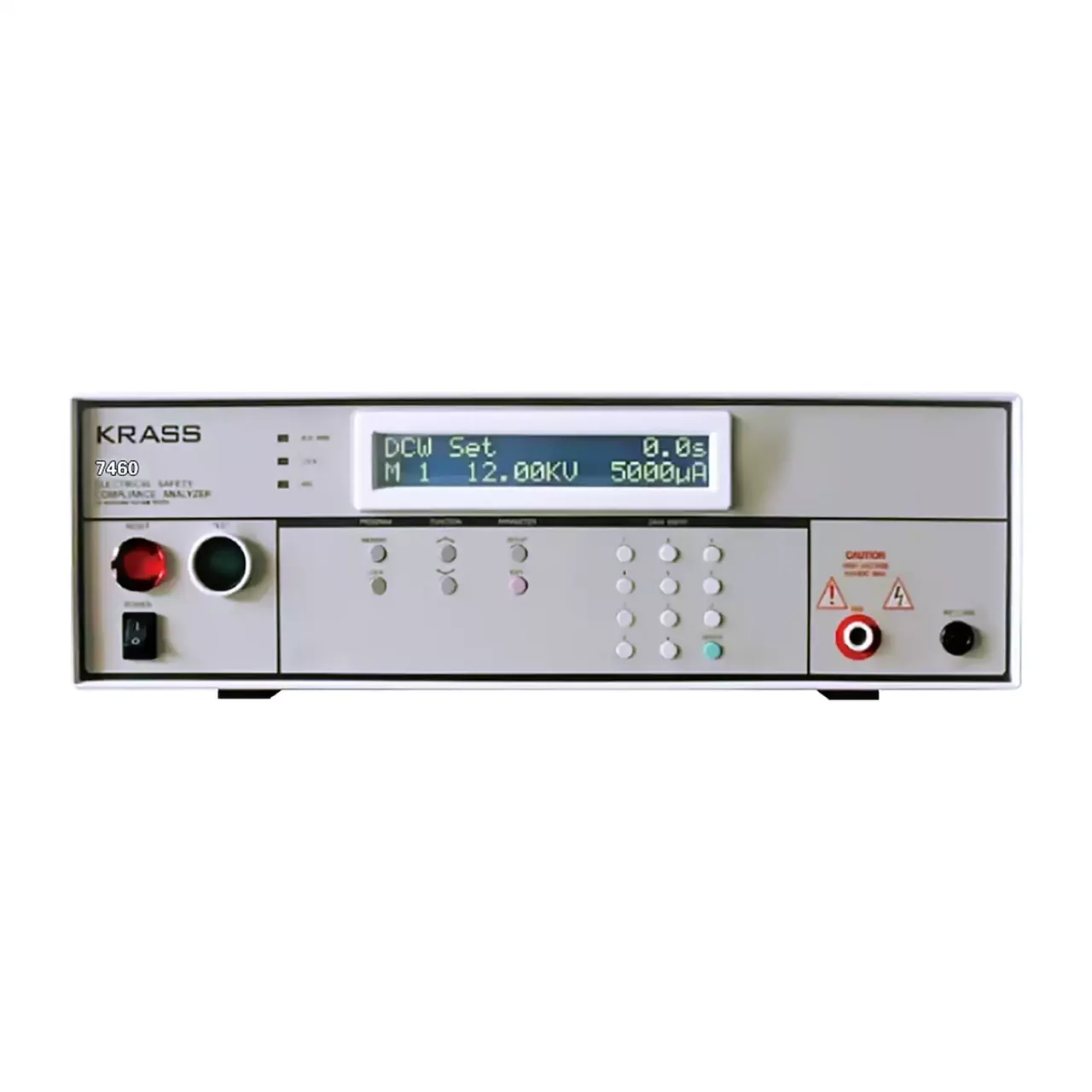
Benchtop high voltage tester seen from the front, with a backlit two-line display at the upper centre, a red reset button and a green test button at the left, function keys and a numeric keypad beneath the display, and high voltage and return terminals at the right

7460 (2 models) · Electrical Safety Testers

10 kV Programmable Withstand Voltage Tester

Programmable high voltage withstand tester in an alternating and a direct version, with a regulated output, fifty linked program groups, arc detection and remote control.

AC output
0.00 to 10.00 kV at 10 mA, on 7460
DC output
0.00 to 10.00 kV at 5000 μA, on 7462
Voltage resolution
0.01 kV
Leakage limits, AC
Upper 0 to 10.0 mA, lower 0.1 to 10.0 mA

Request a quotation for the LK2670AX

Send the configuration you need and we will confirm availability, lead time and terms. Minimum order quantity is 1 pc.

Request for quotation

Request a quotation - LK2670AX

Send the technical detail and we will confirm availability, lead time and terms. In-stock items ship within 48 hours; customized specifications typically take 2-10 days. Minimum order quantity is 1 pc.

The more of this you can give us, the fewer exchanges are needed before we can quote.
No file chosen
Datasheet, drawing, BOM or photograph. One file, up to 10 MB (PDF, Office, image or ZIP).

By submitting this form you agree that we may contact you about this enquiry. We do not sell or share enquiry data. See our privacy policy.

Items held in stock are dispatched within 48 hours of order confirmation. Customized specifications are produced to order and typically ship within 2 to 10 days. Transit time then depends on the shipping method and destination.

Request a Quote WhatsApp