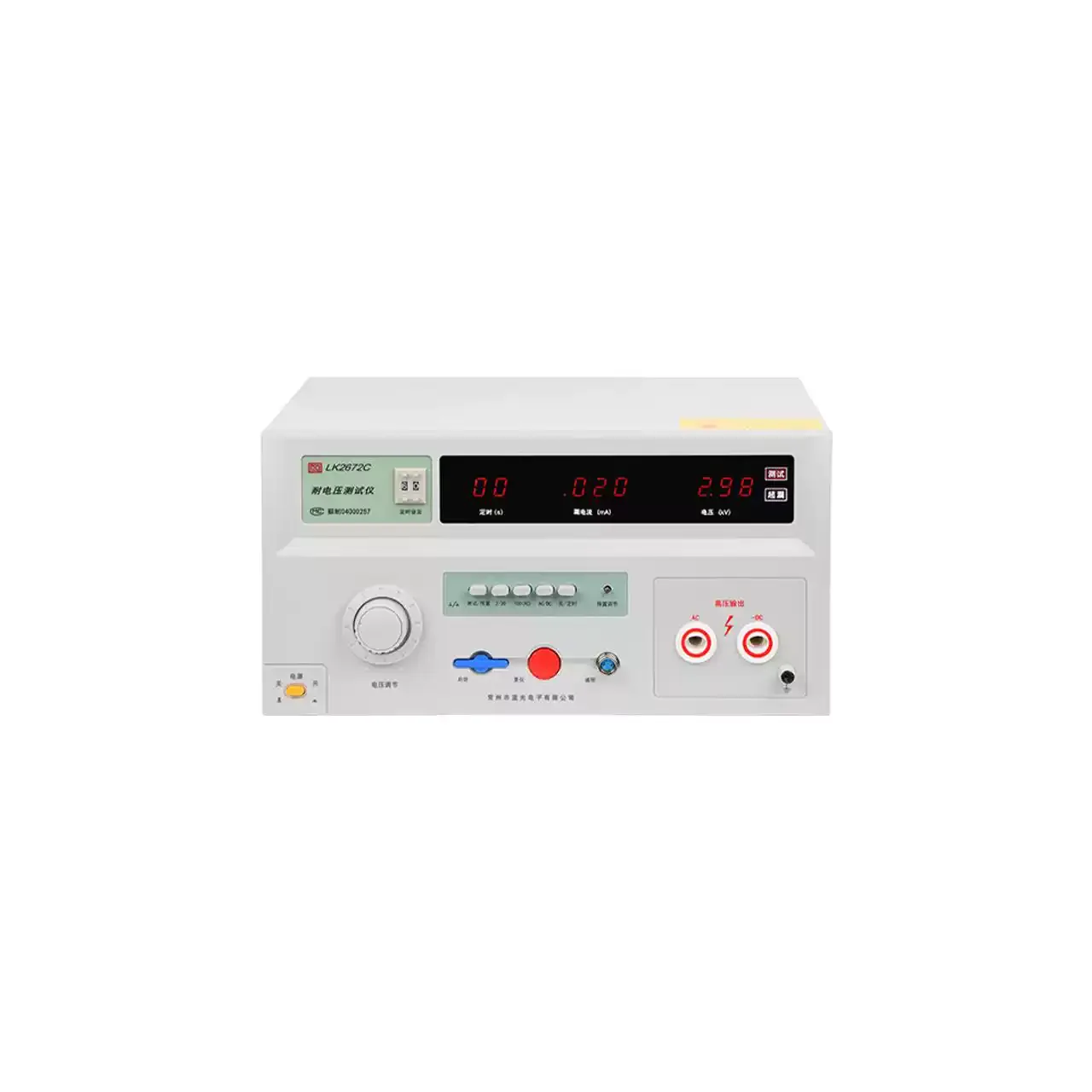
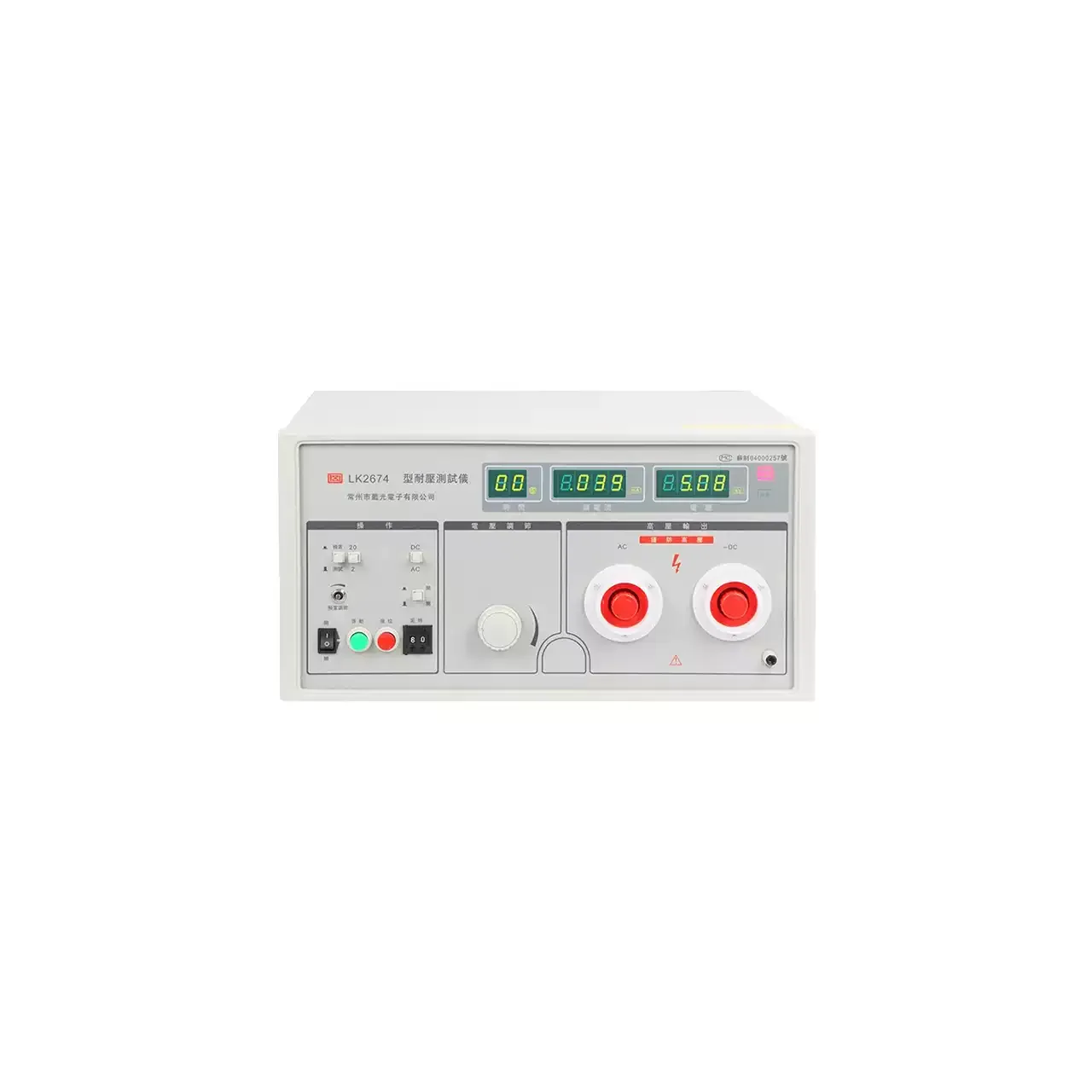
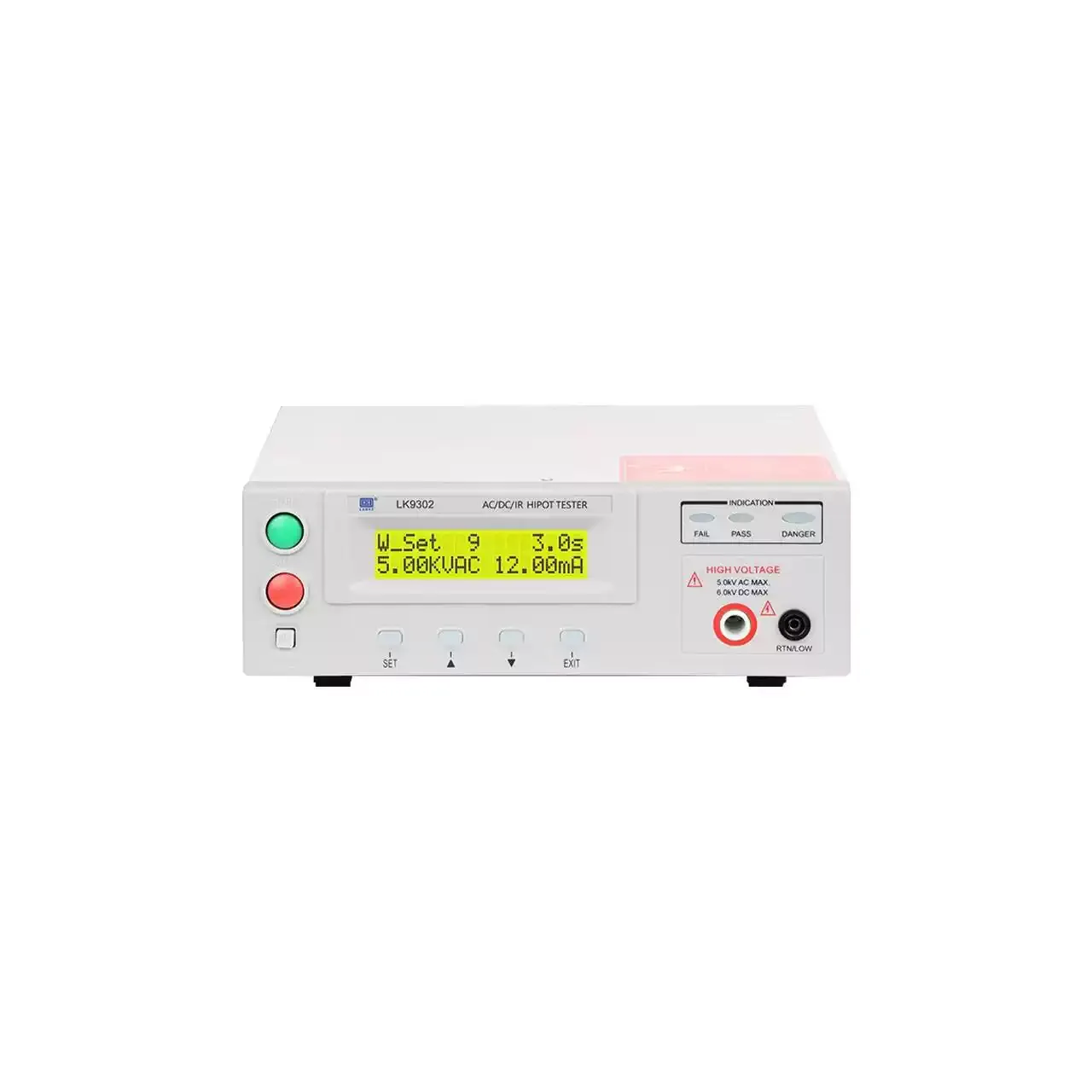
- Voltage ranges
- 0 to 10.000 kV AC and DC on LK149A, LK7005 and LK7015; 0 to 19.999 kV on LK149B and LK7020
- DC accuracy
- ±(1% + 2 counts) on LK149A and LK149B; ±(0.4% of reading + 0.02% of range) on LK7005, LK7020 and LK7015
- AC accuracy
- ±(1% + 2 counts) on LK149A and LK149B; ±(0.8% of reading + 0.02% or 0.04% of range) on the other three
- Resolution
- 0.001 kV on every model
- Operating frequency
- 50 Hz on LK149A and LK149B; 50 or 60 Hz on LK7005, LK7020 and LK7015
- Current measurement
- 0.0001 to 99.99 mA AC or DC on LK7015, in three ranges; not fitted to the other models
- Input resistance
- 100 MΩ on LK7005 and LK7020; 1000 MΩ on LK7015
- Input terminals
- High-voltage INPUT and COM on the front panel, marked for the maximum AC and DC voltage
- Display
- Four-digit red LED readout in kilovolts
- Body
- Benchtop case; dimensions and weight not stated in the material
A hipot tester’s own meter is inside the instrument under test, so it cannot verify itself. The instrument on this page exists for that one job: to sit across the output of a safety tester and report the voltage independently, to a resolution of one volt at ten kilovolts.
Product overview
Five models cover two accuracy classes and two voltage ceilings. LK149A and LK149B measure to 10 kV and 20 kV at ±(1% + 2 counts); LK7005, LK7020 and LK7015 measure to 12 kV and 20 kV at ±(0.4% of reading + 0.02% of range) on direct voltage, with a wider frequency range.
LK7015 is the exception in another way: it also measures current, from 0.1 µA to 99.99 mA in three ranges, which lets it check a tester’s leakage indication as well as its voltage. The other four are voltage-only instruments.
How the digital high voltage meter works
The high voltage is applied to the INPUT terminal and returned through COM. Inside, a resistive divider brings the voltage down to a level the analogue-to-digital converter can read, and the result is displayed directly in kilovolts on a four-digit LED.
The divider is the reason input resistance matters. At 100 MΩ, the meter draws 50 µA at 5 kV; at 1000 MΩ it draws 5 µA. Either is small compared with the current a hipot tester delivers, but the loading is not zero, and a source with a high output impedance will read slightly low. That is why the input resistance is part of the specification rather than a footnote.
The alternating measurement is a rectified and scaled version of the input, and its accuracy is quoted separately from the direct one because the rectifier and the divider behave differently at frequency. The three higher-grade models accept 50 or 60 Hz; the two entry models are specified at 50 Hz only.
How to select the right digital high voltage meter
Start with the highest voltage to be measured. A bench that verifies 5 kV testers is served by any model; a bench that verifies 10 kV and 15 kV testers needs the 20 kV models, because a meter taken above its range is both inaccurate and unsafe.
The second question is accuracy. The ±1% class is enough to confirm that a tester is roughly where it should be; the 0.4% class is what a calibration procedure with a defined uncertainty budget needs, since the meter’s own error has to be small compared with the tolerance being verified.
The third is frequency. A tester set for a 60 Hz market cannot be verified on a 50 Hz-only meter, so LK149A and LK149B are excluded where 60 Hz testers are in use.
The fourth is current. Where the leakage indication is also being verified, LK7015 is the only model that can do it, and the alternative is a second instrument and a second connection.
Measurement limitations and selection considerations
The meter measures the voltage at its own terminals, not at the item under test. The lead between the tester and the meter, and the lead between the meter and the return, both carry the test current and both drop voltage, so the reading is lower than the voltage at the tester’s output by the drop in those leads. At 5 kV and a milliamp that drop is small; at higher currents it is not.
The display holds its last reading when the input is removed. That is useful on a bench where the reading is written down after the test, and misleading if the operator assumes a blank display means no voltage. The input has to be discharged and the reading checked rather than assumed.
The meter has no autoranging on the two entry models, and the range is fixed by the model rather than selected. A 20 kV meter reading 200 V shows four digits but only three of them are significant, which is a resolution limit rather than an accuracy one.
Finally, a voltage meter says nothing about the current a tester delivers or the shape of its waveform. A tester can indicate the right voltage and still fail a leakage test, and verifying the voltage is one check in a calibration, not the whole of it.
Every value below is taken from source documentation. Where a parameter is not stated in the available material it is marked as information required rather than estimated.