- Output voltage
- 0 to 15 kV, 0 to 20 kV, 0 to 30 kV or 0 to 50 kV depending on model
- Output type
- AC on the AC models; AC and DC on the AC/DC models, selected by a front-panel switch
- Leakage range
- 0 to 2 mA or 10 mA on the standard models; 0 to 2 mA or 20 mA on the + models
- Accuracy
- ±(5% + 5 counts); ±(5% + 3 counts) on the 15 kV and 20 kV models
- Test time
- 1 to 99 s, stopped automatically at the end of the interval
- Output capacity
- 200 VA to 1000 VA depending on model
- Display
- Three LED digit groups for time, voltage and current
- Protection
- Voltage breakdown protection with over-leakage alarm
- Body
- 430 × 225 × 430 mm; 30 kg on the 15 kV and 20 kV models, 50 kg on the 30 kV and 50 kV models
Below about five kilovolts a hipot tester is a bench instrument. Above twenty it becomes a piece of equipment with its own clearance distances, and the fixture around the sample matters as much as the instrument. This range runs from 15 kV to 50 kV in one 430 mm body, with the alternating and direct outputs on separate terminals.
Product overview
Ten models cover four voltage classes. Each class is available as an alternating-only instrument or as one with both alternating and direct outputs, and each is available with a 10 mA or a 20 mA leakage range. The 15 kV and 20 kV models weigh 30 kg; the 30 kV and 50 kV models weigh 50 kg.
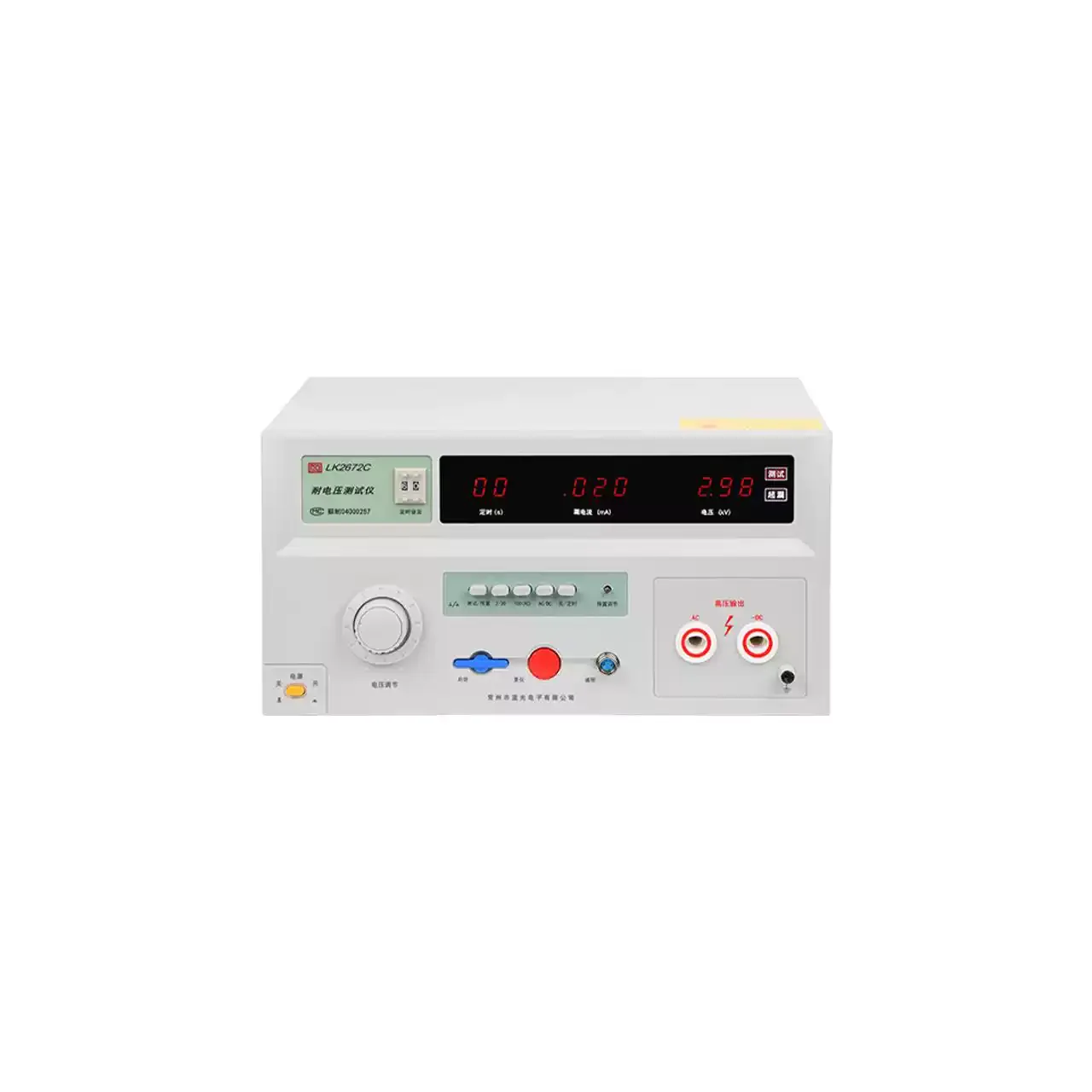
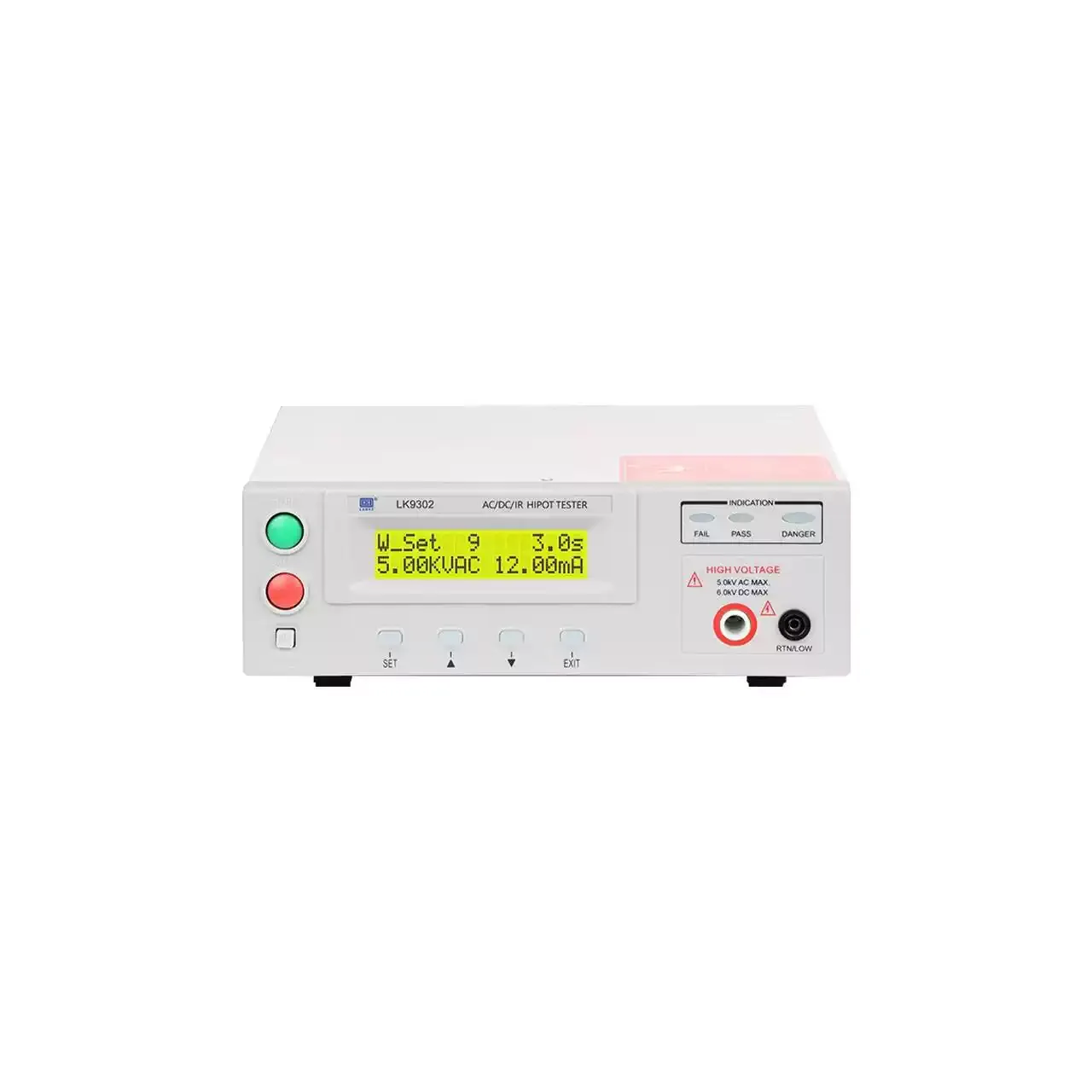
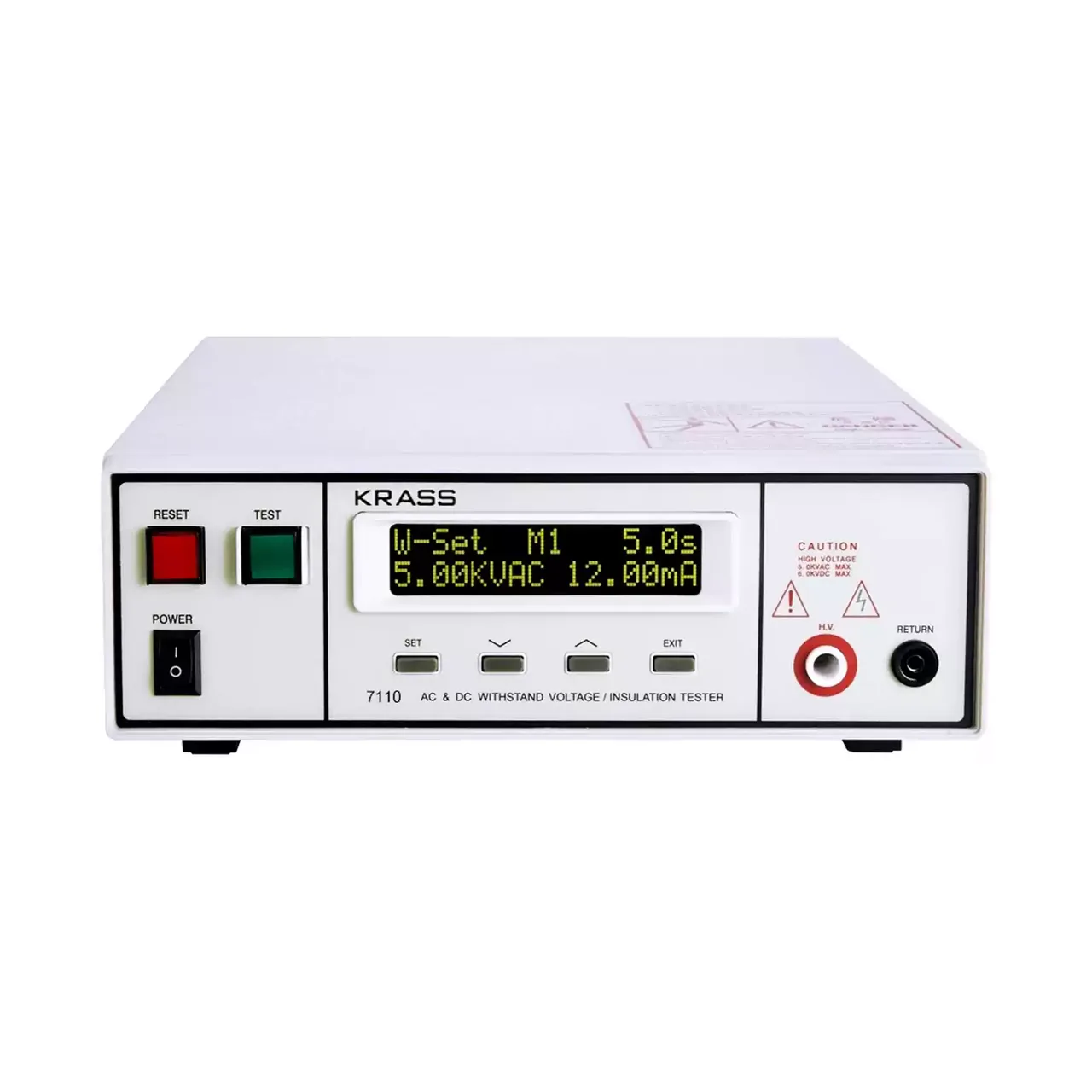
The front panel keeps the same layout across the range: the display strip at the top, the preset and start controls at the left, the voltage knob in the centre and the high-voltage terminals at the right. The alternating and direct outputs are brought out on separate sockets, so a lead is never connected to the wrong source by mistake.
How the ultra-high-voltage hipot tester works
The instrument steps the mains up to the selected voltage and applies it to the sample. The current that flows is displayed alongside the voltage, and the operator sets an upper limit that corresponds to the leakage a good sample should draw.
At these voltages the current is dominated by capacitance rather than by insulation resistance. A sample of a few hundred picofarads draws a milliamp at 50 kV and 50 Hz, so the leakage range and the output capacity have to be chosen together: a 10 mA instrument cannot hold 50 kV into a sample that draws 20 mA, whatever the voltage setting says.
A direct test behaves differently. The sample charges to the test voltage and the current falls to the leakage that remains, which is the quantity a direct test is specified to measure. That is why the AC/DC models exist: the same sample often has both an alternating and a direct requirement.
The breakdown protection watches the current for the sharp rise that a flashover produces and cuts the output. The over-leakage alarm works on the same measurement but at the preset limit, so a sample that is deteriorating is caught before it fails completely.
How to select the right ultra-high-voltage hipot tester
The test voltage from the standard comes first, and it decides the class rather than the model within it. Fifteen kilovolts covers small insulation samples and low-voltage cable; 20 kV and 30 kV cover medium-voltage components; 50 kV covers bushings, insulators and the thicker cable samples.
The second question is the output type. An alternating test alone is served by the AC models; a sample specified in the blocking direction, such as a cable or a capacitor, needs one of the AC/DC models.
The third is the leakage range. The 10 mA models cover most samples; the 20 mA versions exist for samples with more capacitance, and choosing a 10 mA instrument for such a sample produces a failure at the top of the voltage range that is really a capacity limit.
The fourth is the fixture, and at these voltages it is not an accessory. Clearance, guarding, interlocked enclosures and leads rated for the voltage are part of the selection, and the material lists no standard accessory for the 30 kV and 50 kV models, so the fixture has to be specified with the order.
Measurement limitations and selection considerations
The displayed voltage is the open-circuit voltage. Into a sample that draws a high current the instrument reaches its capacity limit before it reaches its voltage setting, so the two figures have to be read together and the actual voltage at the sample confirmed.
The current measurement includes the charging current of the leads and the fixture. At 50 kV a metre of lead has enough capacitance to dominate the reading on a small sample, so the fixture has to be characterised before the limit is set.
Corona and surface leakage are not the same as bulk insulation failure, and both increase with humidity. A sample that reads high on a damp day may be sound, which is why the test conditions have to be recorded alongside the result and the standard’s conditioning requirements followed.
Finally, this is a dielectric test. It says nothing about the resistance of a protective bond, about leakage at operating voltage or about the power a product consumes. A complete safety assessment uses these instruments alongside a bond tester and a leakage tester, not instead of them.
Every value below is taken from source documentation. Where a parameter is not stated in the available material it is marked as information required rather than estimated.