Electrical Test & Measurement · Electrical Safety Testers

SCPI Programmable Hipot and Insulation Tester

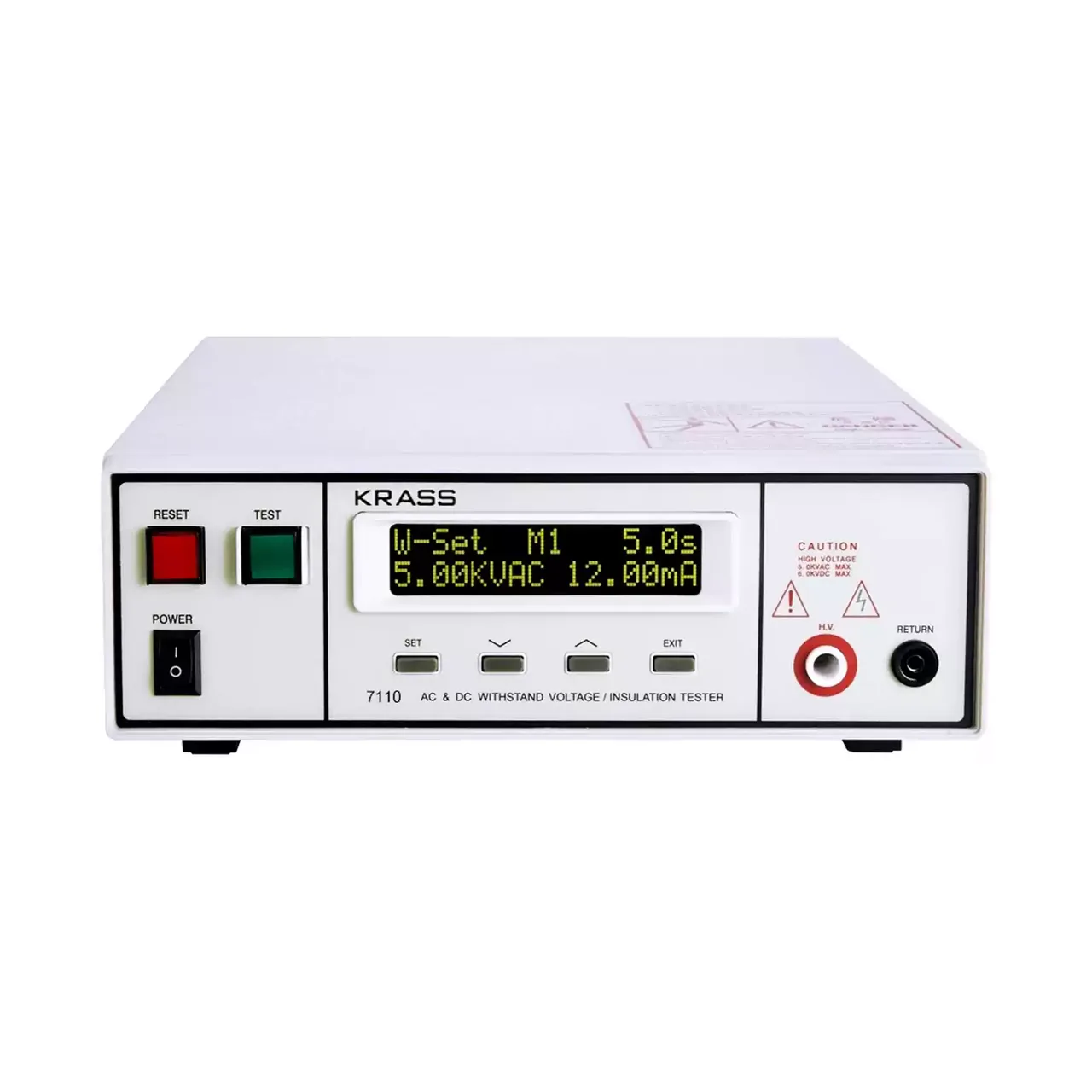
Menu-driven programmable hipot tester with 5 kV AC and 6 kV DC outputs, insulation resistance to 9999 MΩ, four test modes and standard RS232 and PLC interfaces.

LK7110+ (5 models) ·

Key specifications

Output voltage
0 to 5 kV AC on all models; 0 to 6 kV DC on LK7122+, LK7122U and LK9302
Leakage ranges
0 to 12 mA AC and 0 to 5 mA DC; 0 to 999.9 µA AC or DC on LK7122U
Insulation resistance
1 to 9999 MΩ at 100 to 1000 V DC on LK7122+, LK7122U and LK9302
Test modes
Withstand, insulation, withstand then insulation, insulation then withstand; LK7110+ and LK9302B run the withstand mode only
Arc detection
Nine sensitivity levels, for current steps caused by local flashover in the high-voltage loop
Test time
0.1 to 999.9 s, ±(2% + 0.05 s)
Display
16 character by 2 line backlit LCD with menu-guided operation
Interfaces
RS232 and PLC fitted as standard, SCPI command set for remote control and data collection
Memory
Ten storage locations numbered 0 to 9
Body
280 × 100 × 370 mm, 10 kg

A hipot tester that only reports pass or fail tells you the insulation broke down somewhere above the limit. One that ramps to the voltage tells you where. This range is built around the second behaviour, with the ramp, the limits and the test sequence all set from a menu rather than by front-panel knobs.

Product overview

Five models share a 280 mm wide, 10 kg body, a two-line backlit LCD and the same four soft keys. They divide on two questions: whether a direct output is fitted, and whether insulation resistance can be measured. LK7110+ and LK9302B answer no to both; LK7122+, LK7122U and LK9302 answer yes.

The rear panel carries the mains selector, a fused inlet, a nine-pin PLC connector and an RS232 connector. Both interfaces are standard, which is unusual at this size and is the reason the range is specified into automated benches rather than only onto a manual one.

How the programmable hipot tester works

The operator sets a voltage, an upper and a lower leakage limit, a rise time and a test time. Starting the test ramps the output from zero to the set voltage over the rise time, holds it for the test time, and compares the leakage current with both limits throughout.

Exceeding the upper limit means the insulation broke down. Falling below the lower limit usually means the probe is not connected, which is why a floor is set as well as a ceiling. Either condition ends the test and drives the FAIL lamp and the audible tone.

Insulation resistance is a separate measurement at a direct voltage between 100 and 1000 V. The reading is taken after the charging current has decayed, which is why the accuracy figures are quoted separately above and below 500 V: at a lower test voltage the same insulation produces less current and the measurement is harder.

The four test modes decide what runs and in what order. W is the dielectric test, I is insulation, W-I runs dielectric first and insulation second, and I-W reverses them. The order matters when a dielectric test leaves charge on the item that would disturb the insulation reading.

How to select the right programmable hipot tester

Start with the output type. An alternating test alone is served by LK7110+ or LK9302B, which are the two models without a direct output and without insulation measurement. A product that has to be stressed in the blocking direction needs one of the other three.

The second question is the leakage range. Twelve milliamps covers appliances and assemblies; 999.9 microamps on LK7122U is for components whose good-state leakage is far below a milliamp, where a milliamp range would show almost nothing.

The third is the interface. All five carry RS232 and PLC, so the choice is not about whether remote control is possible but about which one the fixture uses. A bench built around SCPI commands uses the serial port; a fixture built around discrete signals uses the PLC connector.

The fourth is the sequence. If the product needs both tests in one program, the mode list decides: LK7110+ and LK9302B run the dielectric test only, while the other three can chain the two in either order.

Measurement limitations and selection considerations

The leakage reading includes the current through the fixture, the leads and the probe. On a low-leakage product that stray current can be a large part of the total, so the lower limit has to be set with the fixture connected, not from the product specification.

The insulation measurement is made at a direct voltage and read after a settling period. A highly capacitive item takes longer to settle than the test time allows, and the reading will drift during the hold; the test time has to be set with that in mind.

The arc detector watches for a fast current step. Its nine levels exist because a long-lead fixture is noisier than a short one, and a detector set too sensitively trips on the fixture rather than on the product.

Finally, the instrument holds a voltage and measures current. It does not measure the resistance of the protective bond, the power the product consumes or the temperature it reaches, and a product that needs those checks needs other instruments rather than a higher setting here.

Features

  • The output ramps to its set value over a programmed rise time instead of switching on, which is what makes the breakdown point observable rather than only the pass or fail result
  • Four test modes chain the dielectric and insulation tests in either order, so one program can run a two-stage sequence without an operator stepping in between
  • Nine arc sensitivity levels, for a fixture whose leads are noisier than the product under test
  • Leakage limits are set at both ends, so a disconnected probe fails the test instead of passing it
  • Insulation resistance is measured across two ranges with separate accuracy figures above and below 500 V, which is where a low test voltage actually changes the result
  • RS232 and PLC are fitted as standard rather than offered as options, with SCPI commands for setting parameters and collecting readings
  • Ten stored programs cover the products a bench sees in a shift, and the keypad can be locked so they are not overwritten
  • Mains input is selectable between 115 and 230 V on the rear panel, so a unit can be moved between markets

Technical specifications

Every value below is taken from source documentation. Where a parameter is not stated in the available material it is marked as information required rather than estimated.
Withstand output
Output voltage, AC0 to 5 kV, ±(2% + 5 V)Standard
Output voltage, DC0 to 6 kV on LK7122+, LK7122U and LK9302, ±(2% + 5 V)Standard
AC current upper limit0.10 to 12.00 mA, ±(2% + 2 counts)Standard
AC current lower limit0.00 to 12.00 mA, ±(2% + 2 counts)Standard
DC current upper limit0.10 to 5.00 mA, ±(2% + 2 counts)Standard
DC current lower limit0.00 to 5.00 mA, ±(2% + 2 counts)Standard
Leakage range, LK7122U0 to 999.9 µA AC or DC in the selection table; the parameter table carries the 12 mA AC and 5 mA DC limits for the same modelInformation required
Rise timeOutput ramps to the set voltage over a programmed gradient, for locating the breakdown pointStandard
Test time0.1 to 999.9 s, ±(2% + 0.05 s)Standard
AlarmFAIL lamp and a long audible tone when the upper limit is exceeded; PASS and DANGER lamps also fittedStandard
Insulation resistance
Test voltage100 to 1000 V DC, ±(2% + 5 V)Standard
Range1 to 9999 MΩ, in a 1 to 1000 MΩ band and a 1000 to 9999 MΩ bandStandard
Accuracy, 1 to 1000 MΩ±(2% + 2 counts) at 500 V DC or above; ±(5% + 2 counts) below 500 V DCStandard
Accuracy, 1000 to 9999 MΩ±(5% + 2 counts) at 500 V DC or above; ±(10% + 2 counts) below 500 V DCStandard
Models with insulation measurementLK7122+, LK7122U and LK9302; LK7110+ and LK9302B do not measure insulationStandard
Control and memory
Test modesW, I, W-I and I-W; LK7110+ and LK9302B offer W onlyStandard
Arc detectionNine levelsStandard
Program memoryTen locations, 0 to 9; the material also mentions five and fifteen groups in other placesInformation required
CorrectionSoftware correction from the front panelStandard
Key lockFront-panel lock to keep settings from being changedStandard
Remote controlPLC inputs Test and Reset; outputs Pass, Fail and Test-in-ProcessStandard
Serial controlRS232 with the SCPI command setStandard
Installation
Mains input115 V or 230 V, 50 or 60 Hz, selected by a switch on the rear panelStandard
Fuse250 V, T3ALStandard
Dimensions280 × 100 × 370 mmStandard
Weight10 kgStandard
Operating environment0 to 40 °C, 75% RH or belowStandard
Standard accessoryLK26002AStandard
Optional accessoryLK26001 high-voltage test probeOptional
Reference standardsDesigned to IEC 60335 and GB 4706.1-2005; metrology requirements of JJG 795-2004 and JJG 690-2003 are cited in the materialStandard

Available models

Selection table
Model Configuration Key ranges Availability
LK7110+ AC withstand only, no insulation function 0 to 5 kV AC; 0 to 12 mA; 0.1 to 999.9 s The entry model, withstand mode only
LK7122+ AC and DC withstand with insulation resistance 0 to 5 kV AC, 0 to 6 kV DC; 12 mA AC, 5 mA DC; 1 to 9999 MΩ The full-function model of the compact group
LK7122U AC and DC withstand with insulation resistance, microamp leakage range 0 to 5 kV AC, 0 to 6 kV DC; 0 to 999.9 µA; 1 to 9999 MΩ For components whose leakage is below a milliamp
LK9302 AC and DC withstand with insulation resistance, arc detection 0 to 5 kV AC, 0 to 6 kV DC; 12 mA AC, 5 mA DC; 1 to 9999 MΩ The model shown in the supplied photograph
LK9302B AC withstand only, no insulation function 0 to 5 kV AC; 0 to 12 mA; 0.1 to 999.9 s The AC-only version of LK9302

Customization

  • Test programs written for a particular product family
  • Rack mounting for a system cabinet
  • Probe and lead sets matched to the fixture

Certification and compliance

Certification documents not yet supplied

Certifications are only published once a certificate copy can be produced, so this section is deliberately empty rather than populated with assumed approvals. Tell us which approvals your application requires and we will confirm what is available for this instrument.

Parameters still to be confirmed

The following are required for a complete specification but are not stated in the documentation supplied to us. They are listed rather than estimated:

  • The leakage range of LK7122U, given as 0 to 999.9 µA in the selection table and as the 12 mA AC and 5 mA DC limits in the merged parameter row
  • The number of stored programs, given as five groups in one place, fifteen in another and ten locations numbered 0 to 9 in the storage description
  • Whether LK7122U has the insulation resistance function, since the parameter table notes that only LK7122+ carries it while the selection table lists insulation for both
  • The insulation resistance range of LK9302, given as 1 to 9999 MΩ in the parameter table and 1 MΩ to 10 GΩ on the model card
  • The model name printed on the rear rating label, which the material records as differing from the title
  • Calibration certificate availability and the standard it would be issued against
  • Warranty period and its terms
  • Duty cycle for repeated tests at 5 kV
  • Ingress protection rating, which the material does not state

Frequently asked questions

What does the programmable rise time actually do?

It turns a pass or fail test into a search for the breakdown point. The output climbs to the set voltage over the programmed interval instead of switching on, so a device that breaks down at 3.2 kV shows the failure at that voltage rather than only reporting that the test failed at 5 kV. The leakage reading during the ramp is what identifies the point.

Which model should be chosen for very small leakage currents?

LK7122U, whose leakage range is given as 0 to 999.9 µA. The other models start their useful limit at 0.10 mA, which is a hundred times higher. A component whose good-state leakage is a few microamps would sit at the bottom of a milliamp range, where the reading carries little information.

What has to be confirmed before a quotation?

Whether a direct test is needed, which separates LK7110+ and LK9302B from the other three; whether insulation resistance is required, which excludes the same two models; the leakage current a good sample draws, which decides between the milliamp and microamp ranges; and whether the fixture will be driven over RS232 or PLC.

Related products

Other models in the same range

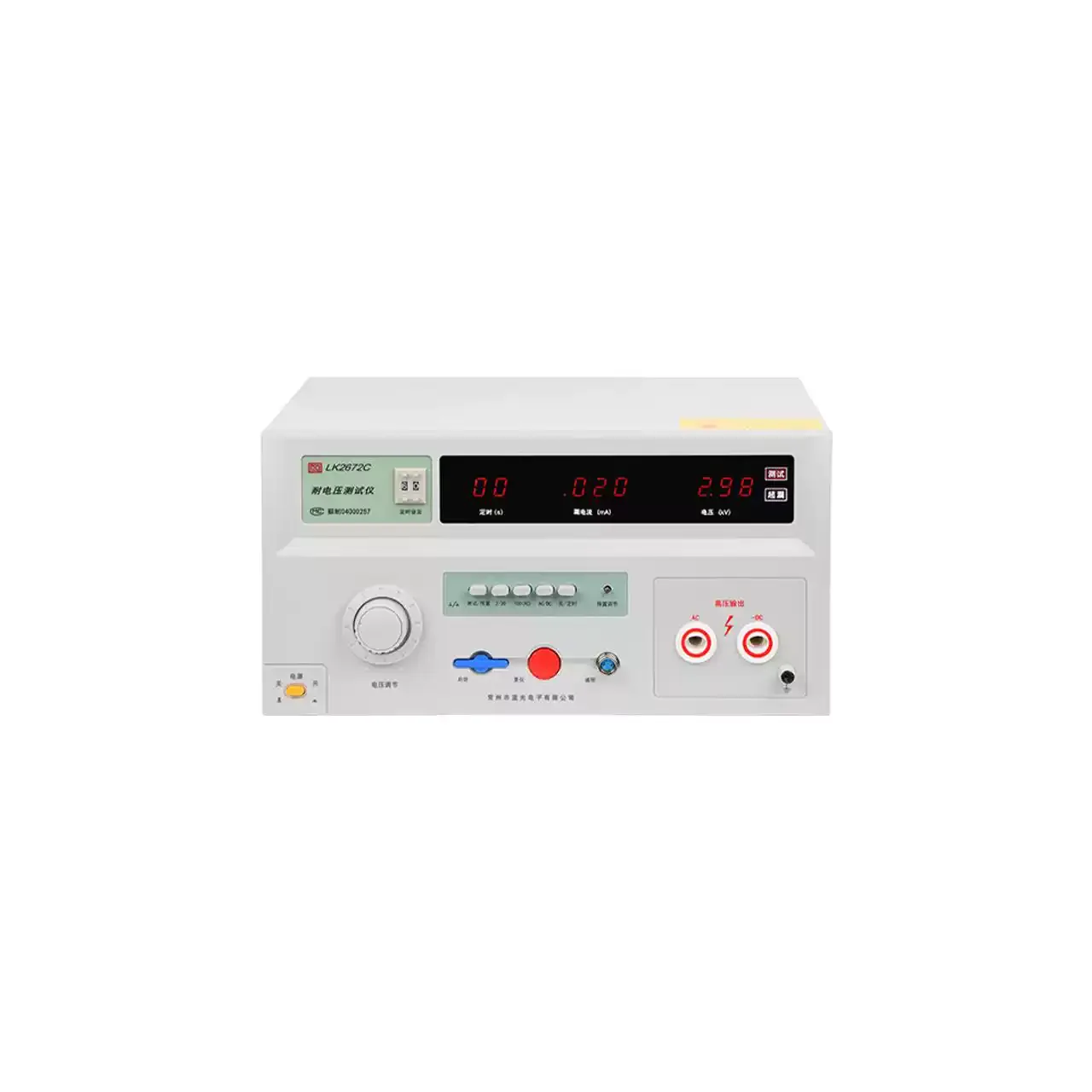
Light grey benchtop tester seen from the front, with a small model plate at the upper left, three red LED readouts across the top centre labelled for time, leakage current and voltage, a large grey voltage knob at the lower left, a row of setting keys in the middle and two high-voltage output terminals at the right

LK2670AX (6 models) · Electrical Safety Testers

Adjustable AC/DC Withstand Voltage Tester

Adjustable hipot tester series with 0 to 5 kV and 0 to 10 kV outputs, leakage ranges to 500 mA, presettable test time and optional PLC control.

Output voltage
0 to 5 kV AC or AC/DC on the 5 kV models; 0 to 10 kV AC or AC/DC on the 10 kV models; 0 to 3 kV DC on LK2673C
Leakage current ranges
0 to 2 mA or 20 mA; 100 mA, 200 mA and 500 mA ranges on the higher-current models
Accuracy
±(5% + 3 counts) across the series
Test time
1 to 99 s as standard, 1 to 999 s on LK2672C+ and available as a custom setting
Compact programmable safety tester shown from the front with the two-line LCD at the upper left, a row of function keys beneath it and the test terminals along the lower right

7110 (8 models) · Electrical Safety Testers

Compact AC/DC Withstand Voltage and Insulation Tester

Compact programmable safety tester with 5 kV AC and 6 kV DC withstand voltage, insulation resistance to 9999 MΩ, five stored programs and PLC remote control.

AC output
0 to 5.00 kV, 12 mA
DC output
0 to 6.00 kV, 5 mA, on four of the eight models
Frequency
50 or 60 Hz, selectable
Leakage limits
0.10 to 12.00 mA AC and 0.02 to 5.00 mA DC, upper and lower set independently
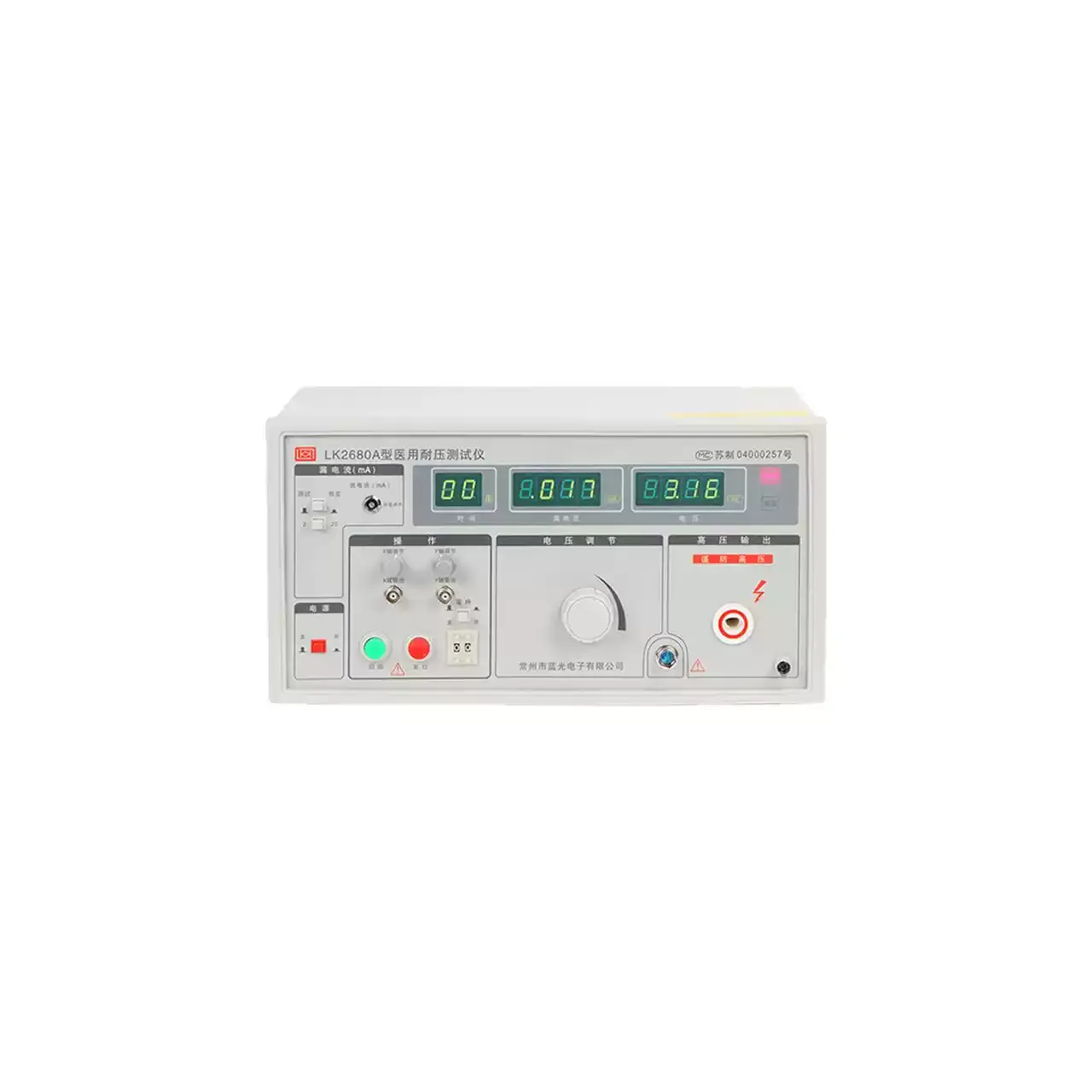
Light grey benchtop tester seen from the front, with a model plate at the upper left, three green LED readouts across the top, a preset control column at the left, a row of setting knobs above a green start key and a red reset key, a large voltage knob in the centre and a single high-voltage output socket at the right

LK2680A (4 models) · Electrical Safety Testers

Medical Electrical Safety Tester

Medical safety test range covering withstand voltage, ground bond resistance and leakage current, with arc detection, true-RMS measurement and 1 MHz response.

Withstand output
0 to 5 kV AC on LK2680A; 0 to 5 kV AC or DC on LK2680D
Leakage ranges
0 to 2 mA or 20 mA, AC on LK2680A and LK2680CX; AC or DC on LK2680D
Ground bond
5 to 32 A through 0 to 600 mΩ on LK2680B, open-circuit voltage 6 V or less
Leakage test voltage
0 to 250 V on LK2680CX, with a 500 VA isolation transformer as standard

Request a quotation for the LK7110+

Send the configuration you need and we will confirm availability, lead time and terms. Minimum order quantity is 1 pc.

Request for quotation

Request a quotation - LK7110+

Send the technical detail and we will confirm availability, lead time and terms. In-stock items ship within 48 hours; customized specifications typically take 2-10 days. Minimum order quantity is 1 pc.

The more of this you can give us, the fewer exchanges are needed before we can quote.
No file chosen
Datasheet, drawing, BOM or photograph. One file, up to 10 MB (PDF, Office, image or ZIP).

By submitting this form you agree that we may contact you about this enquiry. We do not sell or share enquiry data. See our privacy policy.

Items held in stock are dispatched within 48 hours of order confirmation. Customized specifications are produced to order and typically ship within 2 to 10 days. Transit time then depends on the shipping method and destination.

Request a Quote WhatsApp