- AC withstand
- 200 to 5000 V, 0.10 to 25.00 mA, 1 to 300 s
- DC withstand
- 0 to 10 mA at 0.3 to 6 kV on LK9661D only
- Insulation resistance
- 1 to 2000 MΩ at 500 or 1000 V DC
- Ground bond
- 5.0 to 30.0 A into 10.0 to 600 mΩ, 1 to 60 s
- Leakage current
- 0.05 to 20.00 mA at 50 to 280 V, dynamic or static
- No-load power
- 30 to 6000 W at 50 to 280 V and 0.20 to 30.00 A
- Program memory
- 100 programs of eight steps each, each with its own model name
- Sequence time
- A standard set of tests completes in about eight seconds, as stated in the material
- Display
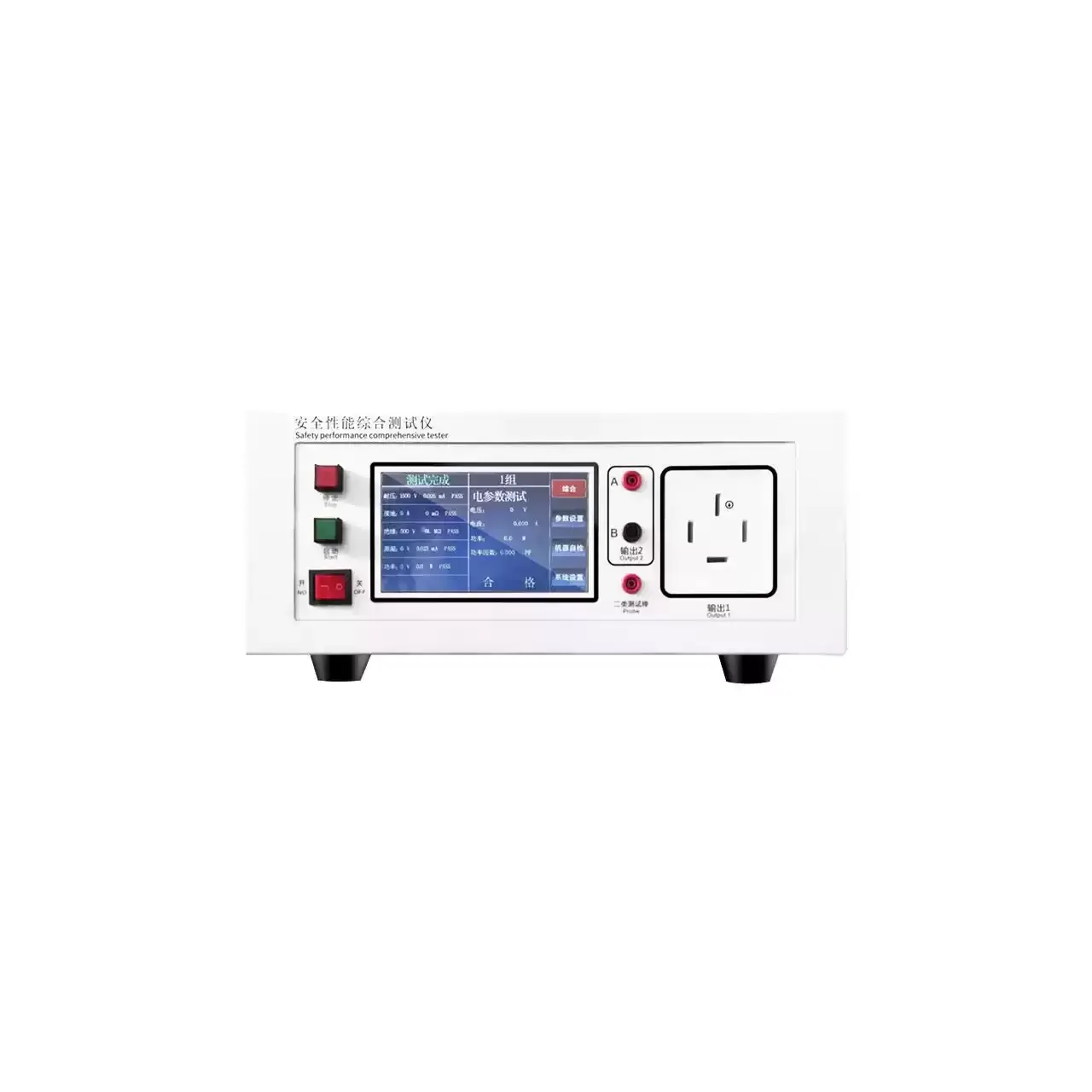
- 5.7 inch blue background LCD with a guided menu
- Body
- 435 × 134.8 × 550 mm, 15 kg
A safety compliance sequence is five or six measurements of the same product, and the cost of running them on separate instruments is not the equipment but the handling between them. This range puts the whole sequence in one box, in one program, on one connection.
Product overview
Three models share a 435 mm wide, 15 kg body and a 5.7 inch blue LCD. LK9661 and LK9661U run five tests: alternating withstand, insulation resistance, ground bond, leakage current and no-load power. LK9661D adds a direct withstand test, which is what makes it the six-function model.
The differences beyond that are small: LK9661U adds a USB port to the RS232 fitted to the other two. All three hold a hundred programs of eight steps, each named after the product it tests, so a line with many models can switch over without re-entering parameters.
How the six-in-one safety tester works
The instrument runs the tests in the order written into the program. The alternating withstand test ramps to as much as 5 kV and compares the current with an upper and a lower limit; the direct test, where fitted, does the same at up to 6 kV.
The insulation test applies 500 or 1000 V DC and reads the resistance after the charging current has decayed. The ground bond test drives up to 30 A through the protective conductor and reads the milliohms across it, judging the result either as a resistance or as a voltage drop depending on how the standard is written.
The leakage test energises the product at 1.06 times its rated voltage and measures the current returning through a human body network, in either a dynamic or a static condition. The power test then runs the product at its rated voltage and measures the active power it draws with no load.
A digital closed-loop controller corrects the output against mains fluctuation throughout, which is what keeps the applied voltage at the programmed value when the bench shares a supply with other equipment.
How to select the right six-in-one safety tester
The first question is whether a direct withstand test is needed. If it is, LK9661D is the only choice; if the product is tested only with alternating voltage, the other two do the same work for less.
The second is the interface. LK9661U adds USB to the RS232 that all three carry, which matters if results are exported to a memory stick rather than streamed to a computer. The PLC and alarm lamp connectors are on all three.
The third is the leakage network. Three human body networks are offered as an option and others can be made to order, so the standard the product is tested against decides what has to be specified at the order rather than at commissioning.
The fourth is the program count. A hundred programs of eight steps is a large number, and a line that runs a handful of products will not use it; a line that runs many will find it the difference between a changeover that takes seconds and one that takes a shift.
Measurement limitations and selection considerations
Every test shares one set of leads and one fixture, so a fault in the fixture affects all five or six results. The fixture has to be characterised before the limits are set, particularly for the ground bond and leakage tests, where lead resistance and stray capacitance are a large fraction of the reading.
The ground bond upper limit changes with the test current: 600 mΩ is allowed at 5 to 10 A, 300 mΩ at 11 to 25 A and 200 mΩ at 26 to 30 A. A program written for one current will not be valid at another, and the limit has to move with the current step.
The leakage and power tests run at multiples of the rated voltage, so the rated voltage has to be entered correctly. A product rated at 230 V tested at a 220 V setting is not tested to its standard, and the error is invisible in the result.
Finally, a combined instrument reports each test but does not interpret the combination. Whether a product passes is decided by the standard it is built to, and the instrument only supplies the numbers the standard asks for.
Every value below is taken from source documentation. Where a parameter is not stated in the available material it is marked as information required rather than estimated.