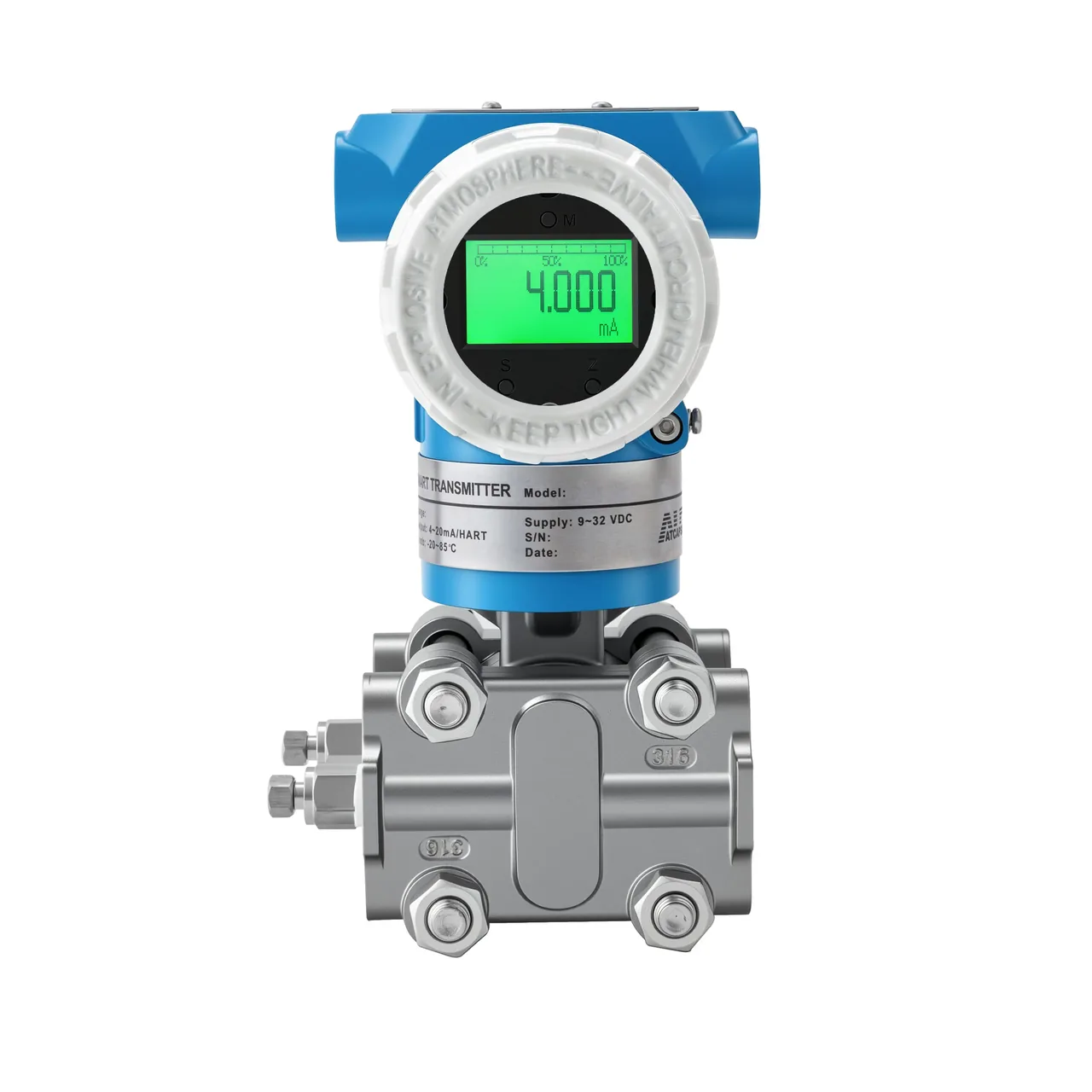
What a differential pressure transmitter is
A differential pressure transmitter measures the difference between two pressures and sends that difference as a signal. It is the instrument behind flow across an orifice, level in a tank, the pressure drop across a filter and the draught in a furnace - four duties that look unrelated until the measurement itself is examined.
The boundary against its neighbours is the number of ports and what they are connected to. A gauge transmitter has one process connection and measures against atmosphere. An absolute transmitter measures against a sealed vacuum reference. A differential transmitter has two connections and measures between them, which is why it can cancel a static head that would otherwise sit on top of the reading.
The figure that is most often confused in a quotation is the static pressure. The differential range is what the instrument measures; the static pressure is what the instrument sits on. A cell built for a small difference can still be destroyed by a high line pressure, and the two ratings are separate numbers rather than one.
How a differential pressure transmitter measures
A diaphragm separates the high and low sides. The pressure difference deflects it, and the deflection is converted into an electrical signal proportional to that difference. Because the diaphragm sees both pressures, the static pressure acts on both sides at once and largely cancels; what remains is the difference the instrument is asked to measure.
Two practical consequences follow. The instrument needs two process connections and piping that brings both legs to it, and the legs have to be arranged so that they see the same conditions - which is what a manifold and a pair of impulse lines are for. And the diaphragm is the only part in contact with the medium, so its material, and the fill fluid behind it, decide what the instrument can survive.
The failure mode is worth understanding before the installation is designed. A blocked or partly filled leg does not stop the transmitter; it keeps producing a plausible difference. The error appears as a slow disagreement with a total taken elsewhere, which is why impulse lines are commissioned and checked rather than assumed.
Configuration choices
Most of the specification is fixed by these decisions rather than by the accuracy class. Each one constrains the next, which is why they are settled in order.
| Configuration | Options to fix | What it actually decides |
| Differential range | A low span in pascals, a mid span in kilopascals, or a high span in megapascals | What the instrument can resolve. A cell built for megapascals cannot resolve a few hundred pascals, which is why the low end is a separate form rather than an option on the main range. |
| Static pressure rating | The line pressure the instrument sits on, separately from the difference it measures | Whether the cell survives the installation. This is a separate rating from the differential range and is the figure most often left out of an enquiry. |
| Flange arrangement | Direct mount, single flange with a seal, or double flange with two capillaries | How the instrument is connected and whether a static head is cancelled. A double flange puts the vessel head on the low side so that it cancels; a single flange or a direct mount is simpler where there is no head to cancel. |
| Diaphragm and fill fluid | Stainless steel, Hastelloy or tantalum, with a fill suited to the temperature | Whether the instrument survives the medium. The diaphragm is the only wetted part, and the fill fluid sets the temperature the assembly can take. |
| Output and protocol | A 4-20 mA signal with or without HART, a digital bus, or a low-range voltage output | What reads the instrument. The control system decides this, and the choice is separate from the measurement itself. |
How to choose a differential pressure transmitter
| Factor | Why it decides the answer | How to settle it before enquiring |
|---|
| What the difference is used for | Flow, level across a closed tank, filter drop and duct pressure are the same instrument but are specified differently. | Say what the difference represents, and give the calculated differential rather than the line pressure alone. |
| Static pressure on the line | A low-range cell can be destroyed by a high line pressure even where the difference it measures is small. | Give the maximum line pressure, separately from the differential range. |
| Whether a static head has to cancel | This decides between a single flange and a double flange with two capillaries. | Say whether the measurement is on a closed tank, and give the vessel height and the liquid density. |
| Flange standard already on the line | The drilling has to match, and it is the item that most often delays an order. | Give the flange standard, size and pressure class, or send a photograph of the mating flange. |
The nearest alternatives
These are the types an enquiry for a differential pressure transmitter usually turns out to be, and the point at which the choice is genuinely decided.
| Nearest alternative | What separates it from a differential transmitter |
| Pressure transmitters | One process connection, measuring against atmosphere. Simpler and cheaper where the pressure itself is the figure wanted, and unable to cancel a static head the way a two-port instrument can. |
| Differential pressure gauges | Reads the same difference on a dial and sends nothing. Chosen where the drop is read at the filter rather than logged, and where no supply or signal wiring exists. |
| Pressure gauges | Single-port local indication. Useful as a check on the line pressure, but it gives no answer at all to the question a differential instrument is asked. |
| Pressure switches | Produces a contact at a set point. Where the requirement is to act on a differential rather than to measure it continuously, a switch is the simpler instrument. |
Where a differential transmitter and a local gauge are both wanted, a three-valve manifold gives a place to equalise the legs for zeroing without breaking the impulse lines.
What to include in the enquiry
The first reply can be a quotation rather than a set of questions if the enquiry carries these. Where a figure is not known, send the duty description and we will confirm what it implies.
- What the pressure difference represents: flow, level, filter drop or duct pressure
- Differential range, and the normal working differential
- Maximum static pressure on the line, separately from the differential range
- Whether the measurement is on a closed tank, and the vessel height and liquid density if it is
- Diaphragm material and, where relevant, the fill fluid
- Flange standard, size and pressure class, or the existing mating flange
- Medium and its temperature
- Output and protocol the control system expects
- Quantity, destination port and required delivery date