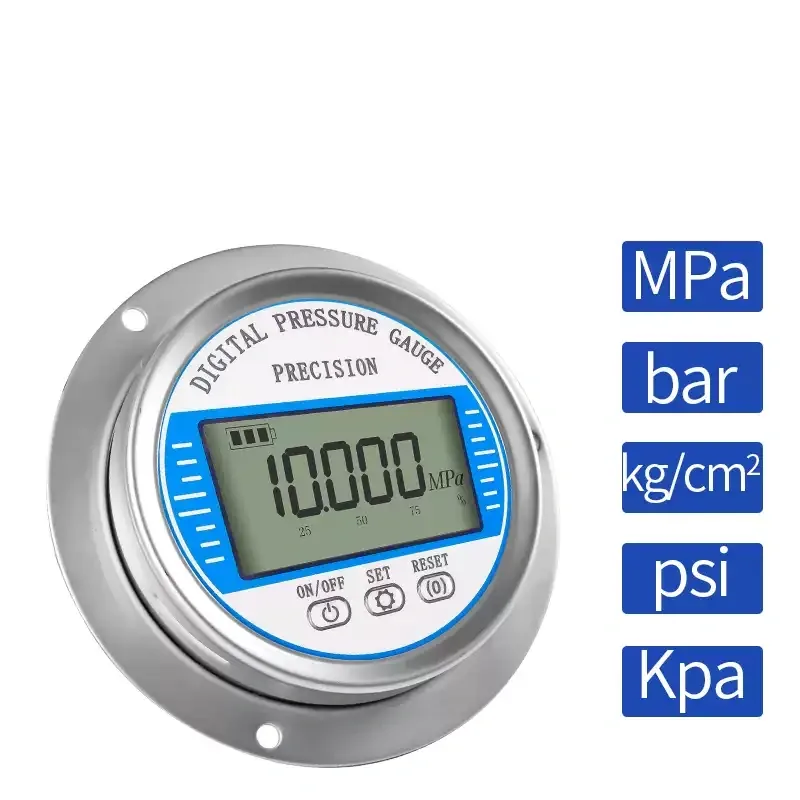
What a digital pressure gauge is
A digital pressure gauge reads the pressure at the point where it is mounted and shows it as a number. It replaces the dial and the pointer with a sensor, an electronic circuit and a liquid-crystal display, and it keeps the property that matters most for a local instrument: nothing leaves it.
The boundary against its neighbours is worth stating plainly. A dial gauge shows the same pressure as the position of a needle, which is quick to read at a glance and impossible to write down without interpretation. A transmitter produces a continuous signal and is chosen when the value has to travel. A pressure switch produces a contact at a set point and nothing else. A digital gauge sits between the dial and the transmitter: it gives a number that can be recorded, but it does not send that number anywhere unless the form carries an output.
What decides the choice is not the display but three figures that move together: the span, the accuracy class available on that span, and the supply. A display with four digits and three decimal places looks precise on every range, and on a wide span that resolution is far finer than the class supports - which is why the class and the span have to be read together rather than separately.
How a digital pressure gauge measures
A pressure sensor converts the applied pressure into an electrical signal. The electronics linearise that signal, apply any temperature compensation the design provides, and drive the display. The reading is a number rather than a position between graduations, so it can be recorded without a judgement about where the needle sits.
Two consequences follow from the electronics. The resolution is set by the display rather than by the sensor, so the number of decimal places says nothing about accuracy on its own. And the instrument needs a supply, which is either a battery or a low-voltage feed; that single fact decides whether the gauge can be installed where no wiring exists, and it also introduces the one failure mode a dial gauge does not have.
The accuracy class is stated against full scale, exactly as it is for a dial instrument. That means the permitted error is a fixed amount wherever the reading happens to be, and a gauge read near the bottom of a wide span reports a larger absolute error at the working point than the same class on a narrower span. A finer class costs more and is only worth paying for where the number is used as a reference rather than as an indication.
Configuration choices
Most of the specification is fixed by these decisions rather than by the accuracy class. Each one constrains the next, which is why they are settled in order.
| Configuration | Options to fix | What it actually decides |
| Pressure reference | Gauge, vacuum, or a compound span crossing zero | What the instrument can show at all. A gauge-only form will not read below atmosphere and a vacuum-only form has no scale above zero, so the reference is settled by the duty before the maximum pressure is discussed. |
| Span and range placement | The maximum pressure, and where the normal working pressure sits within it | What the class is worth in practice, and whether the display resolution means anything. A working pressure near the top of a narrower span uses both the class and the resolution; the same pressure near the bottom of a wide span uses neither. |
| Accuracy class | A standard class, a finer class, or a class quoted as a percentage of span | The permitted error, and the price. A class and a percentage of span are different quantities, so the basis has to be confirmed rather than inferred from the number. |
| Supply and output | Battery with local reading only, or a low-voltage feed with an analogue output | Whether the number can leave the instrument. A battery form is read at the gauge; a transmitting form feeds a controller or a logger. This is the choice most often left until after the price is asked for. |
| Process connection | Thread family, size and standard | Whether the gauge fits the port and seals. Parallel and tapered threads carry the same nominal sizes and do not interchange, and the connection is usually the only wetted part the buyer thinks to specify. |
How to choose a digital pressure gauge
| Factor | Why it decides the answer | How to settle it before enquiring |
|---|
| Normal working pressure | It sets the span and the portion of the scale that is actually read, and therefore what the class delivers at the point of interest. | State the pressure the line usually holds, not only its maximum, and any spike or test pressure it may see. |
| Whether the value has to travel | A local reading and a signal to a control system are different instruments, and confusing them leads to a battery gauge doing a transmitter job. | Say whether the number is read at the gauge, logged, or acted on by a controller. |
| Medium and its temperature | The wetted parts and the electronics have separate limits, and a hot line can exceed the housing limit while the wetted parts are within theirs. | Give the medium and its normal temperature, and say whether the gauge sits on a hot line or a cold one. |
| Supply available at the point | A battery form needs no wiring but introduces a replacement interval; a low-voltage form needs a feed that may not exist at the tapping point. | Say whether a supply is available, and whether the installation can reach the gauge for a battery change. |
The nearest alternatives
These are the types an enquiry for a digital pressure gauge usually turns out to be, and the point at which the choice is genuinely decided.
| Nearest alternative | What separates it from a digital pressure gauge |
| Pressure gauges | Shows the same pressure as a needle on a dial. Needs no supply, tolerates heat and vibration that would end an electronic instrument, and is read at a glance rather than recorded. The digital form is chosen where the number itself has to be written down or resolved finely. |
| Pressure transmitters | Produces a continuous signal for a control system. A digital gauge with an output approaches this, but a transmitter is specified for the signal, the range and the process connection rather than for the display. |
| Pressure switches | Produces a contact at a set point and nothing else. Where the requirement is to act on a pressure rather than to read it, a switch is the simpler instrument; where both are wanted, they sit side by side. |
| Differential pressure gauges | Reads the difference between two ports rather than one pressure against atmosphere. Used across filters and flow elements, where the useful figure is the drop rather than the line pressure. |
A digital gauge and a mechanical gauge can be mounted on the same tapping point through a manifold where both a local dial and a recorded number are wanted.
What to include in the enquiry
The first reply can be a quotation rather than a set of questions if the enquiry carries these. Where a figure is not known, send the duty description and we will confirm what it implies.
- Normal working pressure, maximum pressure and any test or spike pressure
- Whether the reading crosses zero, or is entirely above or below atmosphere
- Accuracy class required, and whether it is quoted as a class or as a percentage of span
- Whether the number is read locally or sent to a control system
- Thread type, size and standard at the tapping point
- Medium and its normal temperature
- Whether a supply is available at the gauge, or a battery form is needed
- Ambient conditions: heat, vibration, weather and washdown
- Quantity, destination port and required delivery date