Temperature Measurement · Temperature Recorders

64-Channel Temperature Recorder

Temperature recorder built from 8 to 64 channels, with 8 GB flash memory that holds data through a power cut, four-level alarms and a choice of a 5 in keyed or 7 in touch panel.

LK1008S (4 models) ·

Key specifications

Channels
8, 16, 24, 32, 40, 48, 56 or 64
Accuracy
0.2% ±2 digits, thermocouple excluded; the model cards state 0.2% + 0.5 °C
Display range
−999.9 to 1999.9
Probes
Type K supplied; S, R, N, E, J, T, B, PT100, PT1000 and Cu50 by type
Sampling
Fastest refresh 100 ms; all channels recorded once per second
Memory
8 GB flash, retained through a power loss
Display
5 in resistive touchscreen with keys, or 7 in capacitive touchscreen
Live-circuit rating
500 V DC and 380 V AC
Supply
AC 85 to 265 V, 50 or 60 Hz
Alarms
Upper-upper, upper, lower and lower-lower per channel, with the events stored

Sixty-four channels is a different class of instrument from eight. It is not the same box with more terminals: the wiring, the scan, the memory budget and the way the data is read all change. This range is built as one family across that whole span, which is unusual at this price level.

Product overview

The range runs in eight-channel steps from eight to sixty-four, in two panels. The S series has a 5-inch resistive touchscreen with physical keys beside it; the W series is a 7-inch capacitive panel with no keys at all. Both use the same inputs and the same memory, and above 32 channels the touch panel is the only option.

The front carries the screen, a USB host socket for a flash drive, the power switch and the keypad on the keyed version. The rear carries the channel terminals in blocks of eight, the mains inlet and the fuse. Grouping the terminals in eights is a small thing that matters at 64 channels: a technician wires four banks and checks each bank, instead of working through one continuous row.

Data appears three ways. The table shows every channel with its name, its value and its running maximum, minimum and average; the bar graph puts the channels side by side against a span; the curve plots them against time. Channel names are typed at the panel, so a record reads as a set of locations rather than a list of numbers.

How the 64-channel temperature recorder works

A sampling board sits between the terminals and the 32-bit processor, and the two talk over a fast link. That architecture is why the scan can be short: the processor is not doing the analogue work itself, it is collecting from a board built for it.

Each input is isolated from its neighbours, so a switching transient on one probe does not appear on the channel beside it. The reading is compensated for the terminal temperature, linearised against the probe type assigned to that channel, and stored with the channel name and a time stamp from a hardware clock.

The memory is flash, which is why a power cut does not end the record. The trade is that the retention depends entirely on how often the instrument writes: a fast scan fills 8 GB in days, a slow one takes months. The instrument does not warn about that in advance, so the interval has to be chosen with the run length in mind.

Alarms are evaluated as each sample is taken and the events are stored alongside the data, which means an alarm can be reconstructed after the fact rather than only witnessed at the time.

How to select the right recorder

Start with the panel, not the channel count, if the instrument will be used by operators rather than engineers. Keys are easier with gloves and in a dirty environment; a touch panel is easier to read across a room and has more space for the curve. Above 32 channels the question answers itself.

Then count the points, and count the terminals as well as the probes. Sixty-four channels means sixty-four leads arriving at one cabinet, and the cable route and the panel space often decide the layout before the channel count does.

Set the interval against the length of the run. A heat-up test measured in minutes wants the fast refresh; a warehouse survey measured in weeks wants minutes, and the memory will then last the whole survey. Trying to do both with one setting is the most common way to lose a record.

Finally, list the probe types with their working ranges. The instrument will display a span far wider than any single probe can survive, and a channel that cannot reach the temperature of the process is a channel that reports nothing useful. Send the point list with types and ranges, the run length, and the panel preference, and a configuration can be proposed.

Measurement limitations and selection considerations

The accuracy figure describes the instrument and excludes the probe. At 64 channels the probe cost dominates anyway, and a matched set of probes is worth more than another decimal place on the display.

The wide display range is not a measurement range. It is the span the display can show, and it is deliberately larger than any probe, so a number on screen tells nothing about whether the probe at that point can survive the process.

Scanning is sequential, so the channels are not sampled at the same instant. At high channel counts the interval between the first and last channel of a scan is at its longest, which matters when a fault moves quickly through a machine.

The 5-inch keyed panel is limited to 32 channels, and that is a hard boundary rather than a preference. A requirement that grows past 32 forces the touch panel, and with it a different mounting depth and a different way of working. Finally, a 64-channel record is a large file: plan how it leaves the instrument, because a USB drive transfer at the end of a long run takes longer than the run itself suggests.

Features

  • One recorder covers every channel count from eight to sixty-four, so a fixture that grows does not force a change of instrument family
  • Eight gigabytes of flash keep data through a power cut, and hold anything from three days to six months depending on the interval
  • A 100 ms refresh for fast work and a one-second full scan for steady logging, from the same instrument
  • Each channel can be named, so a temperature reads as a location rather than a channel number
  • Four alarm limits per channel, and the alarm events are stored with the data rather than only shown
  • The S series keeps physical keys for gloved hands; the W series is a pure 7 in touch panel for a control room
  • Probe types are supported individually, from type T at the low end to type B at the top, with PT100 and Cu50 on the same inputs

Technical specifications

Every value below is taken from source documentation. Where a parameter is not stated in the available material it is marked as information required rather than estimated.
Channels and probes
Channels8, 16, 24, 32 on both the S and W series; 40, 48, 56 and 64 on the W series onlyStandard
Type K (supplied)−50 to 1300 °CStandard
Type N−200 to 1300 °CStandard
Type S−100 to 1600 °CStandard
Type R−50 to 1600 °CStandard
Type B500 to 800 °CStandard
Type E and J−100 to 1000 °CStandard
Type T−100 to 380 °CStandard
PT100 and PT1000−200 to 800 °C and −200 to 200 °CStandard
Cu50−50 to 150 °CStandard
Voltage and current input0-5 V and 0-10 V for pressure, 0-20 mA and 4-20 mA for flow, to orderOptional
Accuracy and sampling
Accuracy0.2% ±2 digits, thermocouple excluded; the model cards and the selection table state 0.2% + 0.5 °CStandard
Display range−999.9 to 1999.9, wider than the range of any single probeStandard
RefreshFastest record refresh 100 ms; every channel recorded once per second at the fastest settingStandard
Processor32-bit ARM, with a screen response under 0.5 sStandard
CompensationPer-channel temperature compensation with selectable compensation modesStandard
ClockHardware real-time clock, error quoted as ±1 minute per yearStandard
Display and storage
S series panel5 in resistive touchscreen with physical keysStandard
W series panel7 in capacitive touchscreen, touch onlyStandard
ViewsData table with maximum, minimum and average, bar graph and live curveStandard
Channel identityEach channel can be given its own name; up to 64 colours selectable for the graphsStandard
Memory8 GB flash, holding between 72 hours and 180 days of data depending on the intervalStandard
RetentionData kept through a power lossStandard
ExportUSB host socket for a flash drive; the same socket is used for firmware updatesStandard
Interface languageEnglish and Chinese menusStandard
Electrical and mechanical
SupplyAC 85 to 265 V, 50 or 60 Hz, marked on the rear plateStandard
Live-circuit rating500 V DC and 380 V ACStandard
Terminal layoutRear terminals grouped eight to a block, marked CH1 to CH8, CH9 to CH16 and onwardStandard
DimensionsNot stated in the materialInformation required
WeightNot stated in the materialInformation required

Available models

Selection table
Model Configuration Key ranges Availability
LK1008S 8 channels, 5 in touchscreen with keys 8 channels; K standard; S, R, N, E, J, T, B, PT100 by type Smallest S series unit
LK1016S 16 channels, 5 in touchscreen with keys 16 channels; same probe set as the eight channel model S series
LK1024S 24 channels, 5 in touchscreen with keys 24 channels; same probe set as the eight channel model S series
LK1032S 32 channels, 5 in touchscreen with keys 32 channels; same probe set as the eight channel model Largest S series unit
LK1008W 8 channels, 7 in capacitive touchscreen 8 channels; same probe set, on the W series panel W series
LK1016W 16 channels, 7 in capacitive touchscreen 16 channels; W series panel W series
LK1024W 24 channels, 7 in capacitive touchscreen 24 channels; W series panel W series
LK1032W 32 channels, 7 in capacitive touchscreen 32 channels; W series panel W series
LK1040W 40 channels, 7 in capacitive touchscreen 40 channels; W series only at this count W series
LK1048W 48 channels, 7 in capacitive touchscreen 48 channels; W series only at this count W series
LK1056W 56 channels, 7 in capacitive touchscreen 56 channels; W series only at this count W series
LK1064W 64 channels, 7 in capacitive touchscreen 64 channels; W series only at this count Largest unit in the range

Customization

  • Voltage or current input channels for pressure and flow signals
  • Probe type and lead length by channel
  • Channel names set at the panel

Certification and compliance

Certification documents not yet supplied

Certifications are only published once a certificate copy can be produced, so this section is deliberately empty rather than populated with assumed approvals. Tell us which approvals your application requires and we will confirm what is available for this instrument.

Parameters still to be confirmed

The following are required for a complete specification but are not stated in the documentation supplied to us. They are listed rather than estimated:

  • Dimensions, absent from the material
  • Weight, absent from the material
  • Whether the W series panel is 7 in, since the technical parameter table gives one merged 5 in cell for all models while the model cards separate S and W
  • Whether 0.2% ±2 digits and 0.2% + 0.5 °C describe the same accuracy figure
  • Whether the 100 ms refresh applies to one channel or to a full scan, since a one-second full scan is given separately
  • The exact meaning of the temperature unit row, which lists K, F and °C
  • Full packing list; no list page was supplied
  • Whether PT1000 and Cu50 are supported on every model, since the compatibility note lists PT100 but the range table includes the other two
  • Calibration certificate availability
  • Warranty period and terms

Frequently asked questions

Does the channel count decide the panel as well?

Partly. The keyed 5-inch panel is offered up to 32 channels; the 7-inch touch panel is offered across the whole range and is the only option above 32. So a 48 or 64 channel requirement settles the panel, while a requirement up to 32 leaves the choice open between keys and touch.

How long will the memory actually last?

Between three days and six months, depending on the interval and the number of channels. That spread is wide because the record is a stream of samples: halving the interval doubles the storage used. Work the figure out for the interval and channel count in the test rather than reading the top of the range as a promise.

Can probes of different types be mixed on one recorder?

Yes, the type is set per channel. What cannot be mixed is the range: a type B probe only spans 500 to 800 °C, and a type T probe stops at 380 °C, so a channel carrying a type T probe will not follow a profile that goes above it even though the recorder itself displays a much wider range. The probe sets the limit, not the instrument.

Related products

Other models in the same range

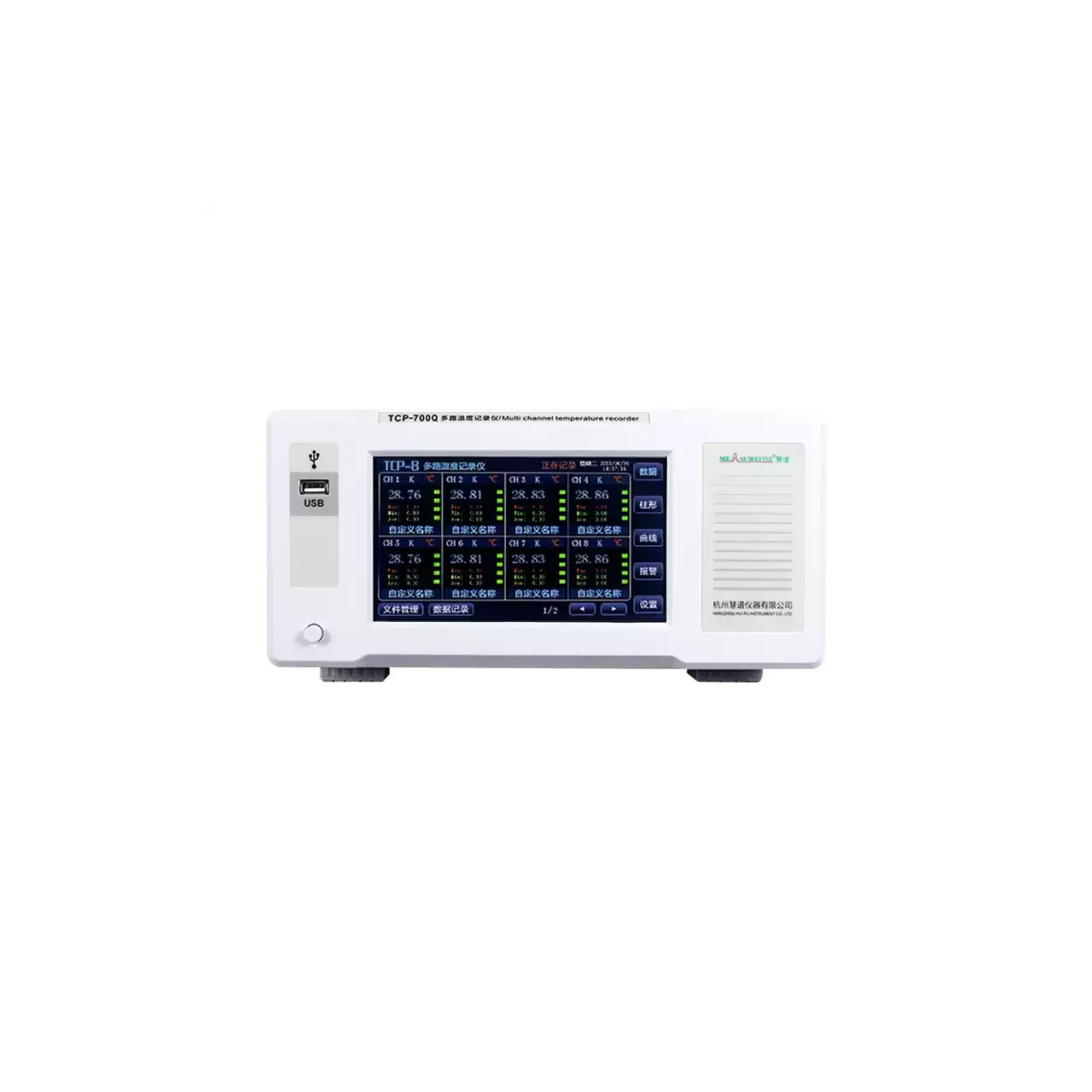
Benchtop temperature recorder seen from the front, with a colour screen showing eight channels of readings in two rows, a USB socket at the left, a round power button below it and a speaker grille at the right

TCP-400 (4 models) · Temperature Recorders

Multi-Channel Temperature Recorder and Scanner

Benchtop multi-channel temperature recorder for 8 to 64 thermocouple inputs, with a colour touchscreen, per-channel correction, four-level alarms and USB logging.

Channels
8 to 64, added in blocks of eight
Thermocouple types
K, S, R, B, N, E, J, T; W5/26 on the XL, 500 and 700 series
Display accuracy
0.2% + 0.5 °C ±2 digits, thermocouple not included
Temperature range
−270 to 2310 °C as marked on most units; a second listing gives −200 to 1300 °C
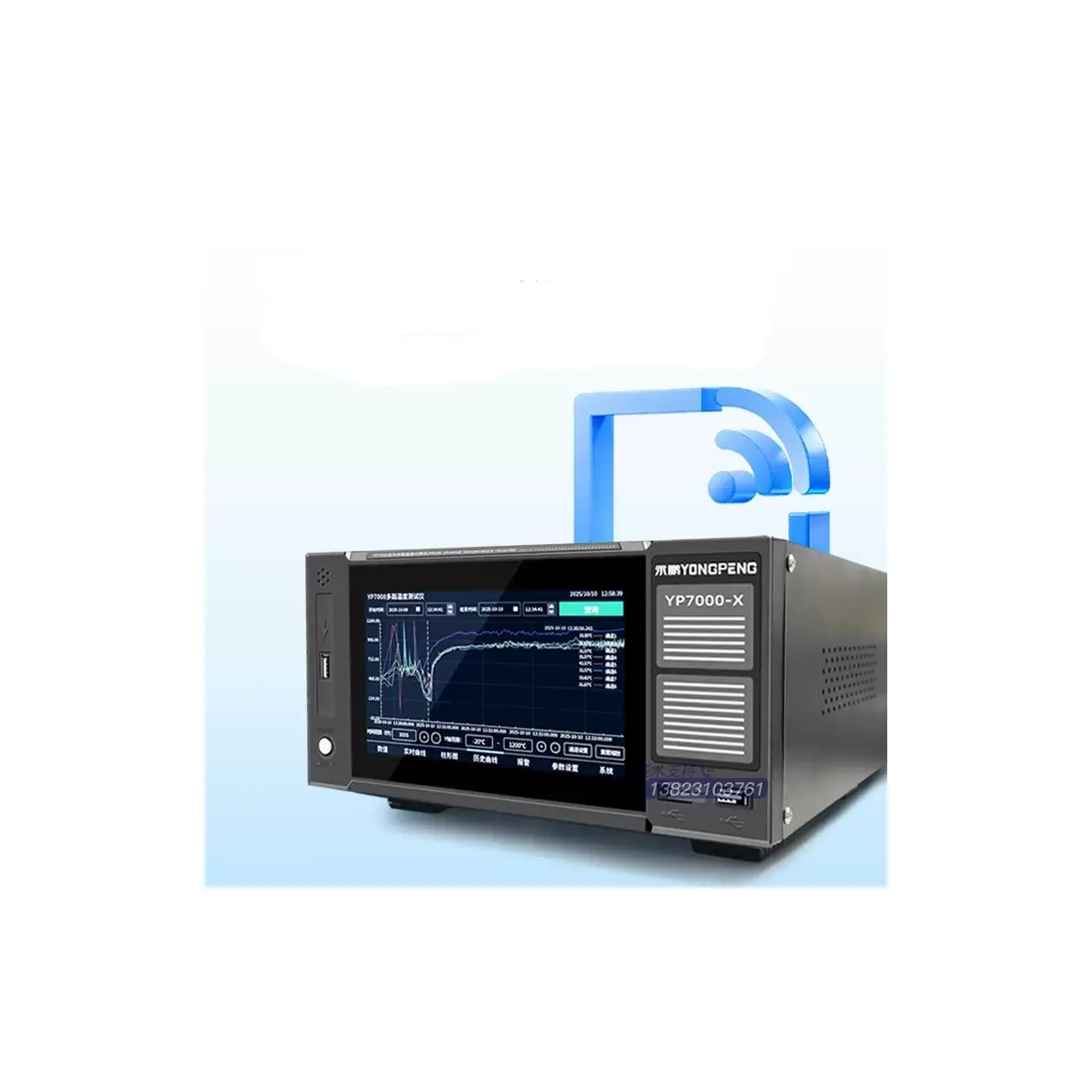
Benchtop recorder with a wide colour screen showing a multi-channel trend plot and a row of page tabs, a USB socket at the left, a round power button beneath it and a vent grille on the right of the front panel

YP4000 (3 models) · Temperature Recorders

Paperless Multi-Channel Temperature Recorder

Touchscreen temperature recorder for 8 to 64 isolated inputs, with four-level alarms, internal storage that survives power loss and wireless viewing from a PC or phone.

Channels
8 to 64, by series
Scan interval
0.1 to 9999 s, adjustable, with three preset speeds
Accuracy
±0.2% ±2 digits, thermocouple excluded
Range
−200 to 1800 °C, sensor dependent
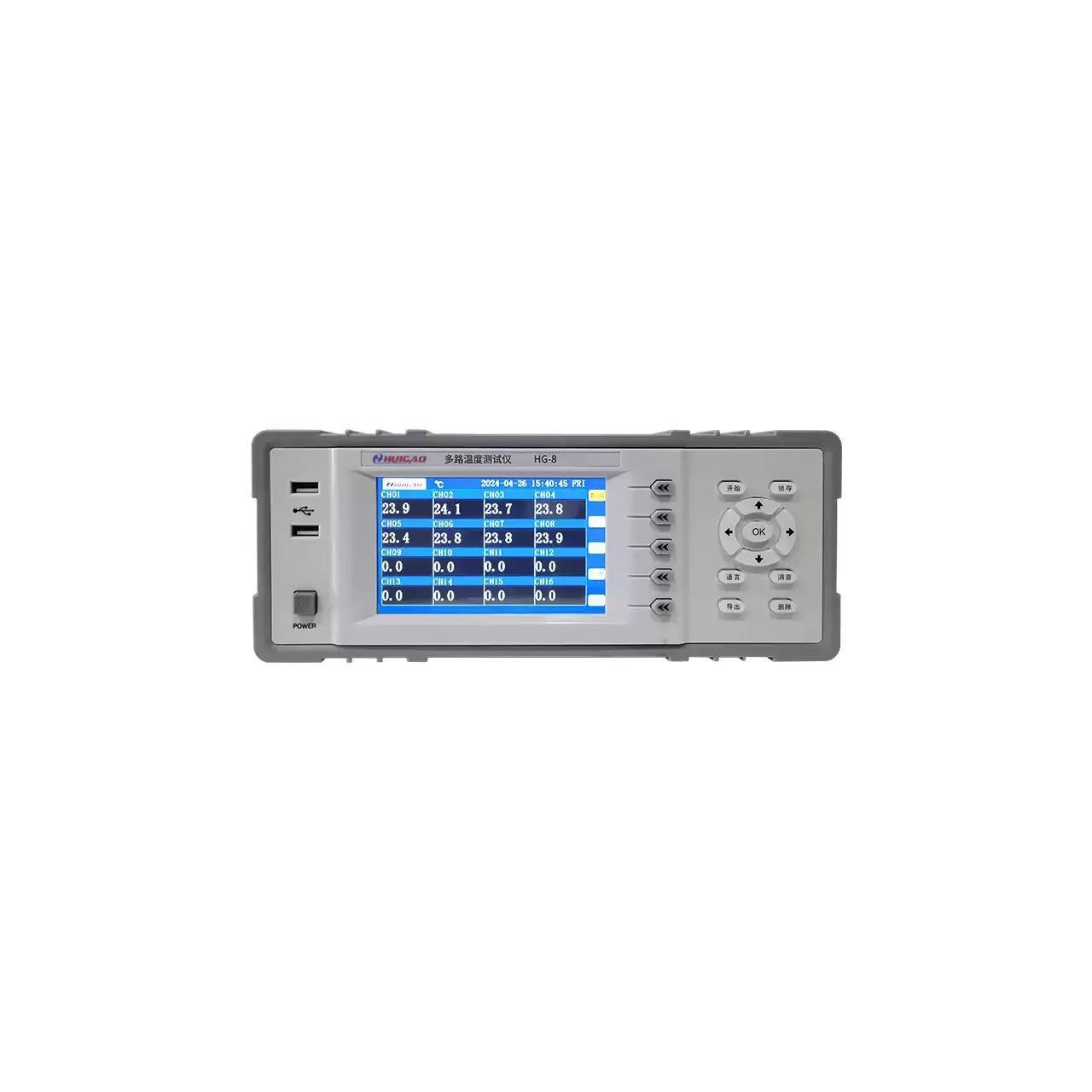
Wide benchtop temperature scanner with a 5 in colour screen showing sixteen channel readings in four columns, two USB sockets at the left, a power switch below them and a keypad with a round OK button at the right

HG-8 (2 models) · Temperature Recorders

Multi-Point Temperature Scanner and Recorder

Eight or sixteen channel thermocouple scanner with a 5 in touchscreen, a scan interval from one second to a day, live-circuit rating and MODBUS RTU communication.

Channels
8 on the HG-8, 16 on the HG-16
Thermocouple types
K, T, J, E, S, N, B and P
Range
−200 to 1350 °C
Accuracy
±0.5% ±0.6 °C

Request a quotation for the LK1008S

Send the configuration you need and we will confirm availability, lead time and terms. Minimum order quantity is 1 pc.

Request for quotation

Request a quotation - LK1008S

Send the technical detail and we will confirm availability, lead time and terms. In-stock items ship within 48 hours; customized specifications typically take 2-10 days. Minimum order quantity is 1 pc.

The more of this you can give us, the fewer exchanges are needed before we can quote.
No file chosen
Datasheet, drawing, BOM or photograph. One file, up to 10 MB (PDF, Office, image or ZIP).

By submitting this form you agree that we may contact you about this enquiry. We do not sell or share enquiry data. See our privacy policy.

Items held in stock are dispatched within 48 hours of order confirmation. Customized specifications are produced to order and typically ship within 2 to 10 days. Transit time then depends on the shipping method and destination.

Request a Quote WhatsApp